 Back
BackAnatomy & Physiology: Special Senses
 5:05
5:05
Terms in this set (57)
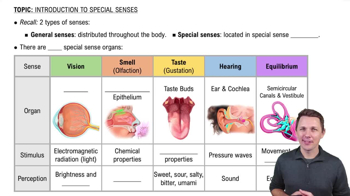
Touch, pain, temperature, pressure, vibration, proprioception
Smell, vision, taste, hearing, equilibrium
General senses are widespread and simple receptors; special senses are located in specific organs with complex receptors.
Nasal cavity, specifically the olfactory epithelium.
Olfactory epithelium and lamina propria.
Modified neurons
Odorants bind receptors → Na⁺ channels open → depolarization → signal sent.
Olfactory nerve (CN I)
Receptor → olfactory bulb → olfactory tract → brain
Only sense that goes directly to cortex without passing through the thalamus.
Basal cells
Loss of smell, e.g., due to COVID-19.
On tongue papillae
Filiform papillae (function in friction)
Fungiform papillae (3–5 taste buds each)
Vallate and foliate papillae (~100 taste buds each)
Taste hairs (microvilli) detect chemicals in food.
Cranial nerves VII (facial) and IX (glossopharyngeal)
Signal → medulla → thalamus → cortex
Sweet, salty, sour, bitter
Detects protein/amino acids
Via ion channels for Na⁺ and H⁺ ions.
Via G-protein coupled receptors (gustducins).
Neurotransmitter release triggers nerve signal.
More sensitive to bitter than sweet tastes.
Replaced approximately every 10 days.
Taste sensitivity declines after age 50.
Fibrous (sclera + cornea), vascular (uvea) (iris, ciliary body, choroid), and neural (retina).
Controls pupil size to regulate light entry.
Dilates the pupil.
Constricts the pupil.
Controls lens shape for accommodation and produces aqueous humor.
Detect dim light and do not detect color.
Detect color and provide high visual acuity.
Area of highest cone density and best vision.
Aqueous humor in anterior cavity; vitreous humor in posterior cavity.
Increased intraocular pressure causing optic nerve damage.
Cloudy lens causing vision impairment.
Near-sightedness: focus is in front of the retina.
Far-sightedness: focus is behind the retina.
Age-related lens stiffening causing difficulty focusing.
Auricle (pinna) and external auditory canal.
Separates outer ear from middle ear and transmits sound vibrations.
Malleus, incus, stapes bones that amplify sound vibrations.
Equalizes pressure between middle ear and atmosphere.
Detect rotational movement for balance.
Detects position and linear movement.
Responsible for hearing.
Mechanoreceptors that detect movement.
Detects horizontal movement.
Detects vertical movement.
Calcium crystals that aid balance by stimulating hair cells.
Displaced otolith crystals causing dizziness.
Receives vibrations from the stapes to transmit into inner ear.
Relieves pressure within the cochlea.
Location of stimulation on the basilar membrane.
Number of hair cells activated.