 Back
BackAnatomy & Physiology: Special Senses Review
 5:05
5:05
Terms in this set (30)
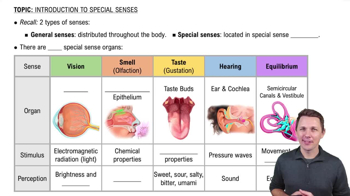
Olfactory receptors are sensory receptors in the nose that detect odorants and initiate the sense of smell.
Taste receptors detect chemicals; vision receptors (photoreceptors) detect light; equilibrium receptors detect head movement and position; hearing receptors detect sound waves.
Salt and sour receptors use ion channels to signal, while sweet, bitter, and umami receptors use G-protein coupled receptors activating second messenger pathways.
Types: fungiform, foliate, circumvallate (all contain taste buds). Filiform papillae provide friction but do not contain taste buds.
Main tastes: sweet, sour, salty, bitter, umami. We are most sensitive to bitter to detect toxins.
Taste buds contain gustatory cells, supporting cells, and basal cells.
Facial nerve (anterior 2/3 tongue), glossopharyngeal nerve (posterior 1/3 tongue), and vagus nerve (throat and epiglottis).
Signals travel via cranial nerves to the medulla, then to the thalamus, and finally to the gustatory cortex in the insula.
Olfactory receptors send signals through the olfactory nerve to the olfactory bulb, then to the olfactory cortex in the temporal lobe.
Olfactory epithelium contains olfactory receptor cells, supporting cells, and basal cells.
Odorants bind receptors, activating G-proteins that increase cyclic AMP, opening ion channels and generating nerve impulses.
Anosmia is the loss or impairment of the sense of smell.
Equilibrium receptors in the inner ear are protected and respond to head movement.
External ear: collects sound; middle ear: transmits vibrations; inner ear: detects sound and balance.
Bony labyrinth is a rigid outer structure; membranous labyrinth is a fluid-filled tube inside that contains sensory receptors.
Sound waves vibrate the cochlear fluid, moving hair cells in the cochlear duct to generate nerve signals.
Humans hear frequencies from about 20 Hz to 20,000 Hz.
Pitch is determined by frequency; volume is determined by amplitude of sound waves.
Hair cells in the vestibule and semicircular ducts detect head position and movement.
They detect linear acceleration and head position relative to gravity using otoliths on maculae.
Otoliths are calcium carbonate crystals; maculae are sensory patches containing hair cells in the utricle and saccule.
Movement shifts otoliths or fluid, bending hair cells and generating nerve signals about head position or motion.
They detect rotational head movements via hair cells in the ampullae.
Signals travel from cochlear hair cells to cochlear nerve, then to brainstem, thalamus, and auditory cortex.
It processes equilibrium information and coordinates balance and eye movements.
By comparing timing and intensity differences of sound between both ears.
Eyelids protect eyes; conjunctiva lubricates; eyelashes and eyebrows protect from debris; lacrimal apparatus produces tears to clean and moisten.
Optic disc: blind spot; rods: detect light/dark; cones: detect color; visual acuity: sharpness; bipolar cells: relay signals; ganglion neurons: send signals to brain.
Accommodation is the eye's ability to change lens shape to focus on near or far objects.
Myopia: nearsightedness; presbyopia: age-related focus loss; hyperopia: farsightedness; astigmatism: irregular cornea curvature causing blurred vision.