How many bones make up the human skeleton and what percentage of body weight do they represent?
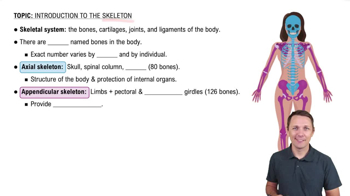
The human skeleton consists of 206 bones which make up about 20% of body weight.
What are the two main groups of bones in the human skeleton?
The skeleton is divided into the axial skeleton (skull, vertebral column, rib cage) and the appendicular skeleton (upper & lower limbs, pectoral and pelvic girdles).
How many bones are in the axial skeleton?
The axial skeleton contains 80 bones.
What are the two sets of bones in the skull?
The skull is made up of cranial bones and facial bones, totaling 22 bones.
What is the function of the cranial bones?
Cranial bones form the vault and base of the skull, surrounding and protecting the brain and organs of hearing and balance.
Name the 8 cranial bones.
The cranial bones include paired parietal and temporal bones, and unpaired frontal, occipital, sphenoid, and ethmoid bones.
What are the three distinct areas of the cranial base?
The cranial base is divided into the anterior fossa (highest), middle fossa, and posterior fossa (lowest).
What is the foramen magnum and where is it located?
The foramen magnum is a large hole at the base of the occipital bone that allows passage of the spinal cord.
What is the significance of the occipital condyles?
Occipital condyles articulate with the first cervical vertebra, allowing head movement.
What are the three parts of the temporal bone?
The temporal bone has the squamous part (forms zygomatic process), tympanic part (surrounds external acoustic meatus), and petrous part (houses middle and inner ear).
What is the sphenoid bone and its key features?
The sphenoid is a complex bone articulating with all cranial bones, containing sphenoid sinuses, greater and lesser wings, pterygoid processes, optic foramina, and the superior orbital fissure.
What is the ethmoid bone and its main components?
The ethmoid bone lies between orbits and nasal cavities, with the cribriform plate, perpendicular plate, crista galli, lateral masses, and nasal conchae.
What are the four main cranial sutures?
The main sutures are coronal (frontal & parietal), squamous (parietal & temporal), lambdoid (occipital & parietal), and sagittal (between parietal bones).
How many facial bones are there and which are unpaired?
There are 14 facial bones; the mandible and vomer are unpaired.
What are the key features of the mandible?
The mandible is the strongest facial bone with a body, rami, mandibular notch, coronoid process, mandibular condyle, alveolar margin, mandibular foramina, and mental foramina.
What is the function of the maxillary bones?
Maxillae hold upper teeth, form the anterior two-thirds of the hard palate, and contain the maxillary sinuses.
What bones form the cheekbones?
The zygomatic bones form the cheekbones and articulate with maxilla, frontal, and temporal bones.
What are paranasal sinuses and their functions?
Paranasal sinuses (frontal, maxillary, sphenoid, ethmoid) are mucosa-lined air-filled spaces that lighten the skull and enhance voice resonance.
What is unique about the hyoid bone?
The hyoid bone does not articulate with any other bone and supports the tongue, aiding swallowing and speech.
Which bones contribute to the nasal septum?
The nasal septum is formed by the perpendicular plate of the ethmoid bone, the vomer, and septal cartilage.
 Back
 4:50
