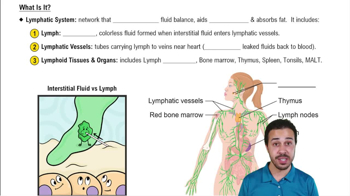
The lymphatic system consists of lymphatic vessels, lymph nodes, and certain other lymphoid organs such as the thymus, spleen, tonsils, and Peyer’s patches.
Source and formation of lymph
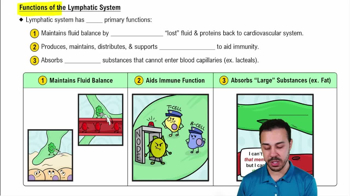
Lymph is formed from excess interstitial fluid picked up by extremely porous lymph capillaries and transported through lymphatic vessels back to the bloodstream.
Function of lymph nodes
Lymph nodes filter lymph, serve as multiplication sites for lymphocytes, and contain phagocytic cells that remove bacteria, viruses, and debris before lymph returns to the blood.
Role of the thymus in immunity
The thymus programs T lymphocytes to become immunocompetent and self-tolerant, overseeing cell-mediated immunity.
Innate (nonspecific) body defenses
Includes physical barriers like skin and mucous membranes, chemical secretions, natural killer cells, phagocytes, complement proteins, interferons, inflammation, and fever.
Function of natural killer (NK) cells
NK cells nonspecifically lyse virus-infected, malignant, or abnormal cells without prior sensitization.
Inflammatory response purpose
Prevents spread of harmful agents, disposes of pathogens and dead cells, and promotes tissue healing.
Phagocytes and their role
Phagocytes like macrophages and neutrophils engulf and destroy pathogens, enhanced by antibodies and complement attachment.
Complement system functions
Complement proteins fix on foreign cell membranes causing lysis, enhance phagocytosis, and amplify inflammatory and immune responses.
How fever protects the body
Fever increases metabolism to speed repair and causes liver and spleen to store iron and zinc, limiting bacterial growth.
Definition of antigen and hapten
An antigen is a large molecule recognized as foreign; a hapten is a small molecule that triggers an immune response only when attached to a body protein.
Two arms of adaptive immunity and their lymphocytes
Humoral immunity is mediated by B cells producing antibodies; cellular immunity is mediated by T cells targeting infected cells.
Development sites of B and T cells
B cells develop immunocompetence in the bone marrow; T cells develop in the thymus.
Role of antigen-presenting cells (APCs)
APCs like macrophages and dendritic cells phagocytize pathogens and present antigen fragments to T cells to initiate adaptive immunity.
Primary humoral immune response
Clonal selection of B cells produces plasma cells that secrete antibodies and memory cells for future rapid responses.
Difference between active and passive immunity
Active immunity is produced by the body with memory; passive immunity is from antibodies received externally without memory.
Structure of an antibody monomer
An antibody has four polypeptide chains (two heavy, two light) forming a Y-shaped molecule with variable antigen-binding sites and constant regions.
Five classes of antibodies
IgM, IgA, IgD, IgG, and IgE differ in structure and function in immune responses.
Functions of antibodies
Antibodies cause agglutination, complement fixation, neutralization, opsonization, and precipitation of antigens.
Roles of helper, regulatory, and cytotoxic T cells
Helper T cells activate B and T cells; regulatory T cells suppress immune responses; cytotoxic T cells kill infected or foreign cells.
Types of organ grafts
Autograft: from self; isograft: from identical twin; allograft: from another person; xenograft: from different species.
Causes of autoimmune diseases
Autoimmune diseases occur when self-tolerance breaks down and immune cells attack the body's own tissues.
Examples of autoimmune diseases
Rheumatoid arthritis, multiple sclerosis, Graves’ disease, type 1 diabetes, systemic lupus erythematosus, and myasthenia gravis.
Most serious immunodeficiencies
Severe combined immunodeficiency disease (SCID) and acquired immune deficiency syndrome (AIDS), caused by HIV infecting helper T cells.
Origin of lymphatic vessels
Lymphatic vessels form by budding off veins during embryonic development.
Effect of aging on immunity
Immune efficiency declines with age, increasing susceptibility to infections, cancer, immunodeficiencies, and autoimmune diseases.
 Back
 3:32