Skip to main content
Anatomy & Physiology
My Course
Learn
Exam Prep
AI Tutor
Study Guides
Textbook Solutions
Flashcards
Explore
Try the app
My Course
Learn
Exam Prep
AI Tutor
Study Guides
Textbook Solutions
Flashcards
Explore
Try the app
Back
Anatomy & Physiology: The Skull
You can tap to flip the card.
How many bones make up the human skull, excluding auditory ossicles?
You can tap to flip the card.
👆
How many bones make up the human skull, excluding auditory ossicles?
The skull consists of
22 bones
, divided into cranial and facial bones.
Track progress
Control buttons has been changed to "navigation" mode.
1/20
Recommended videos
Guided course
2:12
The Skull Example 1
9690
views
221
rank
Guided course
4:42
Introduction to the Skull
17713
views
402
rank
Guided course
3:40
The Skull Example 3
7032
views
134
rank
Terms in this set (20)
Hide definitions
How many bones make up the human skull, excluding auditory ossicles?
The skull consists of
22 bones
, divided into cranial and facial bones.
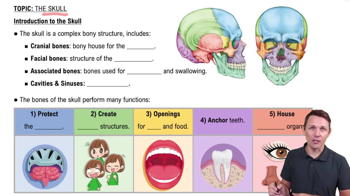
What are the two main groups of skull bones?
Cranial bones
(8) encase the brain, and
facial bones
(14) form the face framework.
Name the 8 cranial bones.
Frontal, parietal (2), temporal (2), occipital, sphenoid, and ethmoid bones.
Name the 14 facial bones.
Maxilla (2), zygomatic (2), nasal (2), lacrimal (2), palatine (2), inferior nasal concha (2), vomer, and mandible.
What type of joints connect most skull bones?
Most skull bones are joined by
immovable sutures
, except the mandible.
What are the two main parts of the cranial cavity?
The
cranial vault
(calvaria) forms the roof, and the
cranial base
forms the floor.
What are the three cranial fossae and their brain regions?
Anterior cranial fossa houses frontal lobes, middle cranial fossa houses temporal lobes, posterior cranial fossa contains the cerebellum.
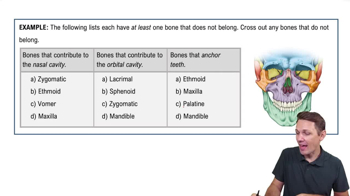
Which bones form the orbit?
Frontal, maxilla, zygomatic, sphenoid, ethmoid, lacrimal, and palatine bones.
What is the function of the paranasal sinuses?
They lighten the skull, filter and humidify air, and enhance voice resonance.
What bones contribute to the nasal cavity walls and septum?
Lateral walls: ethmoid, palatine, inferior nasal conchae, maxilla; septum: hyaline cartilage (anterior), perpendicular plate of ethmoid and vomer (posterior).
What are fontanels and their function in infants?
Fontanels are membranous soft spots allowing skull flexibility during birth and brain growth.
How do male and female skulls differ?
Males have sloped foreheads, prominent supraorbital ridges, ~90° mandibular angles, larger mastoid processes; females have straighter foreheads, less prominent ridges, wider mandibular angles, smaller mastoid processes.
What is unique about the hyoid bone?
It is a small, C-shaped bone in the neck that does not articulate with other bones and supports muscles for swallowing and speech.
Which skull bone contains the foramen magnum?
The
occipital bone
contains the foramen magnum for spinal cord passage.
Which bone forms the lower jaw and is movable?
The
mandible
is the only movable skull bone and holds the lower teeth.
What bones form the hard palate?
The hard palate is formed by the palatine bones and maxillae.
What is the role of the lacrimal bone?
It houses the lacrimal sac involved in tear drainage.
Which bone supports the nasal cavity and forms part of the orbit?
The
ethmoid bone
supports the nasal cavity and forms part of the orbit.
What bones form the cheekbone and part of the orbit?
The
zygomatic bones
form the cheekbones and part of the orbit.
What clinical significance does a fractured hyoid bone have?
A fractured hyoid bone may indicate strangulation in forensic investigations.
 BackBack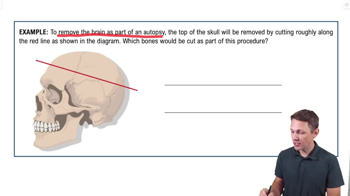
 2:12
2:12