 Back
BackAnatomy & Physiology: Tissue and Epithelial Tissue Basics
 03:32
03:32
Terms in this set (26)
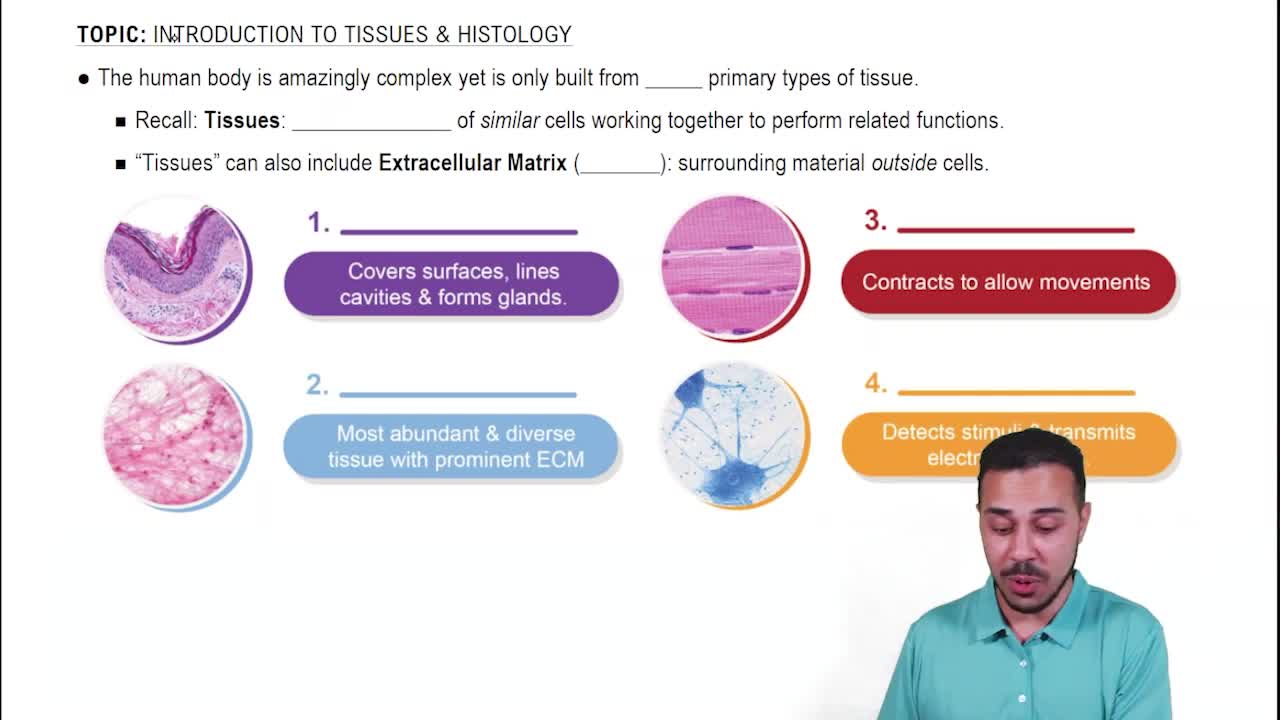
A tissue is a group of cells similar in structure that perform common or related functions to maintain homeostasis in the body.
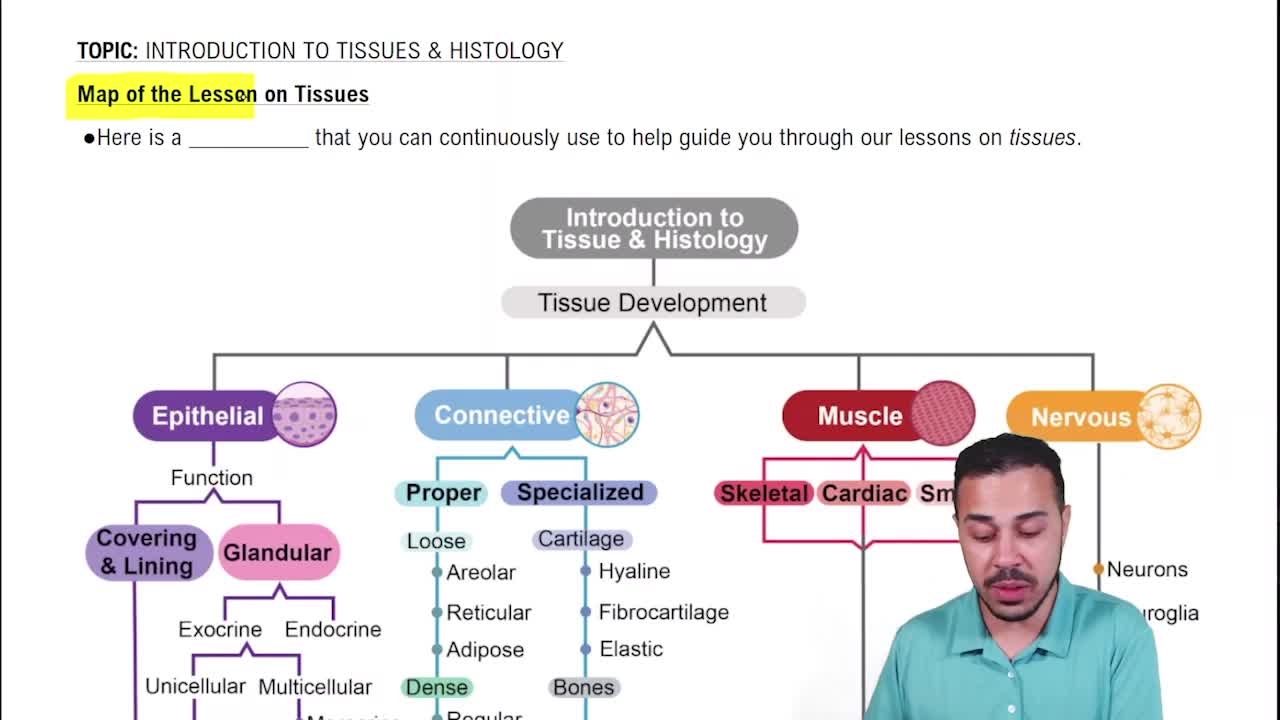
The four basic tissue types are epithelial, connective, muscle, and nervous tissue.
Epithelial tissue covers body surfaces and lines cavities, providing protection, absorption, filtration, excretion, secretion, and sensory reception.
Connective tissue supports, protects, and binds other tissues together.
Muscle tissue contracts to cause movement.
Nervous tissue initiates and transmits electrical impulses.
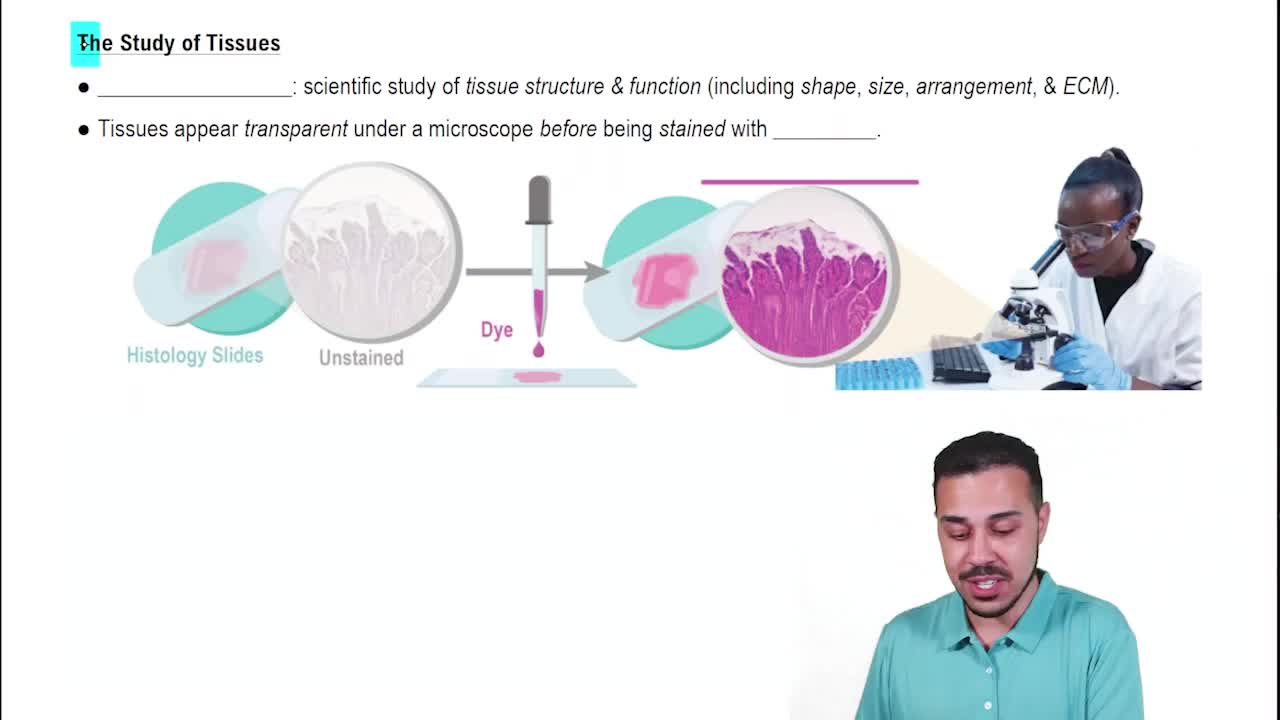
Tissue samples are fixed to prevent decay, sectioned into thin slices, and stained to enhance contrast for microscopy.
TEM shows internal structures; SEM reveals surface details of tissues.
A sheet of cells that covers body surfaces or lines body cavities, including glands.
Covering and lining epithelium and glandular epithelium which forms glands that secrete substances.
Cells have an apical surface exposed to the exterior or cavity and a basal surface attached to underlying tissues.
By specialized contacts such as tight junctions and desmosomes forming continuous sheets.
The basement membrane (basal and reticular lamina) supports and reinforces the epithelium.
Avascular but innervated; nutrients diffuse from underlying connective tissue.
It has a high capacity for renewal, especially in areas exposed to friction or hostile environments.
Simple epithelium has one cell layer; stratified epithelium has two or more layers.
Cell shapes include squamous (flattened), cuboidal (cube-like), and columnar (tall and column-shaped).
Single layer of flattened cells allowing rapid diffusion and filtration; found in kidney glomeruli, lungs, heart lining, and blood vessels.
Single layer of cube-like cells functioning in secretion and absorption; located in kidney tubules and small gland ducts.
Single layer of tall cells, often with microvilli or cilia; functions in absorption and secretion; found in digestive tract and uterine tubes.
Single layer of cells with varying heights giving a false stratified appearance; often ciliated; found in upper respiratory tract.
Multiple layers provide protection in high-abrasion areas like skin and mouth lining.
Stratified epithelium that lines urinary organs and stretches as needed.
By site of product release: endocrine (ductless, hormones into blood) or exocrine (onto surfaces or cavities via ducts).
Unicellular glands (e.g., goblet cells) consist of one cell; multicellular glands (e.g., salivary glands) have many cells.
Include merocrine, holocrine, and apocrine secretion types.