 Back
BackAnatomy & Physiology: Tissue Structure and Function
 03:32
03:32
Terms in this set (26)
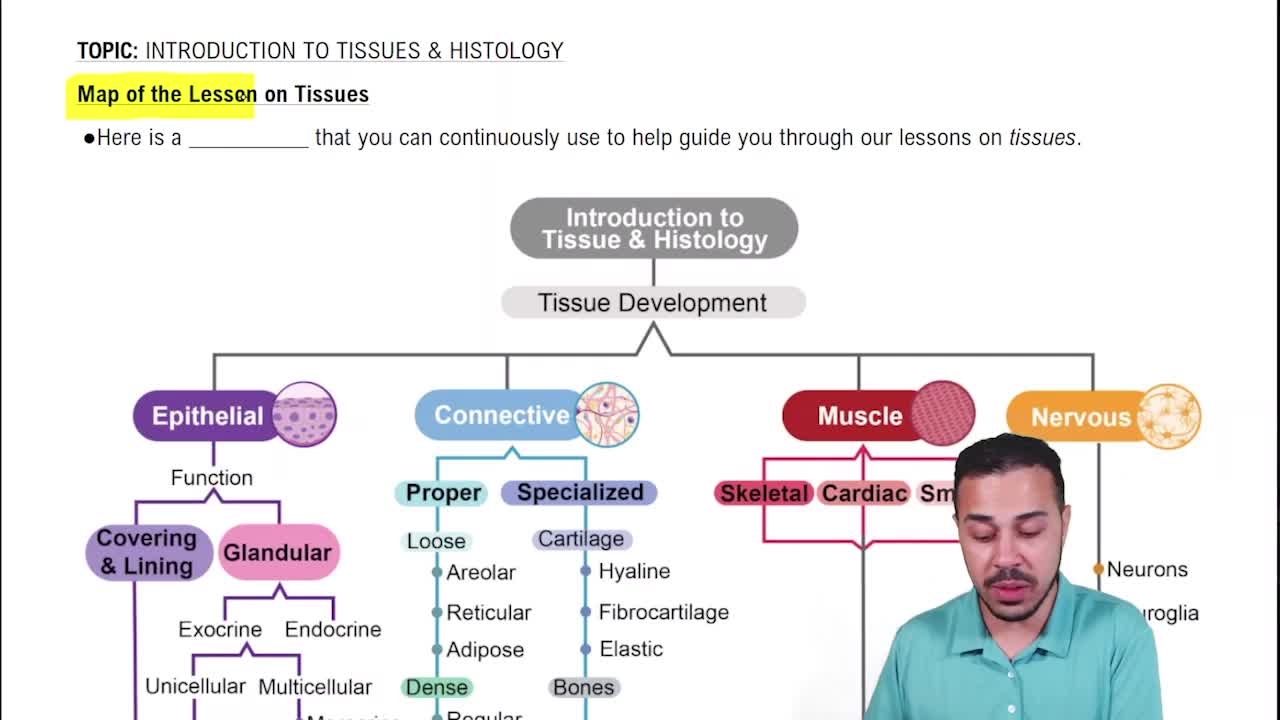
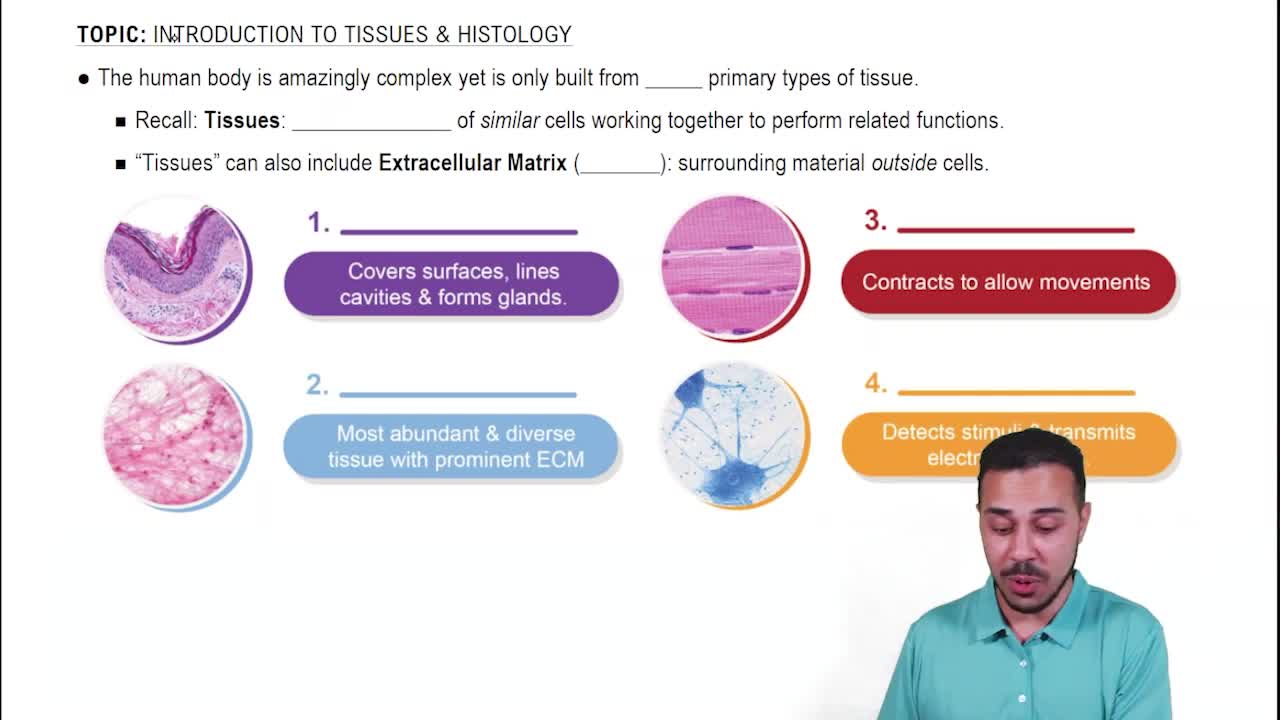
The four basic tissue types are epithelial, connective, muscle, and nervous tissue.
Epithelial tissue is a sheet of cells covering body surfaces or cavities. Its main functions include protection, absorption, filtration, excretion, secretion, and sensory reception.
1. Polarity (apical and basal surfaces)
2. Specialized contacts (tight junctions, desmosomes)
3. Supported by connective tissue
4. Avascular but innervated
5. Regeneration
The apical surface is the upper free side exposed to the body surface or cavity, often with microvilli. The basal surface is the lower attached side facing inward, attached to the basal lamina.
By layers: Simple (one layer), Stratified (multiple layers).
By shape: Squamous (flat), Cuboidal (cube-shaped), Columnar (tall column-like).
Allows rapid diffusion and filtration. Found in kidney glomeruli, air sacs of lungs, lining of heart, blood vessels, and lymphatic vessels.
Single layer of cube-like cells with large, spherical nuclei. Functions in secretion and absorption. Located in kidney tubules and ducts of small glands.
Single layer of tall cells, some with microvilli or cilia, may contain goblet cells. Functions in absorption and secretion of mucus and enzymes. Found in digestive tract and uterine tubes.
Single layer of cells of varying heights that appears stratified. Often ciliated and contains goblet cells. Found in upper respiratory tract and ducts of large glands.
Multiple layers with flat cells at the surface. Protects underlying tissues in areas of high wear and tear like skin and mouth. Can be keratinized or nonkeratinized.
Resembles both stratified squamous and cuboidal; basal cells are cuboidal or columnar. Allows stretching to accommodate urine volume changes. Found in urinary bladder, ureters, and urethra.
By product release: Endocrine (ductless, secrete hormones internally), Exocrine (secrete onto body surfaces or cavities via ducts).
By cell number: Unicellular (e.g., goblet cells), Multicellular (e.g., salivary glands).
Merocrine: secretion by exocytosis.
Holocrine: entire cell ruptures to release secretion.
Apocrine: apex of cell pinches off (controversial in humans).
Connective tissue consists of cells, fibers (collagen, elastic, reticular), and ground substance forming the extracellular matrix.
Collagen fibers: strongest, provide tensile strength.
Elastic fibers: allow stretch and recoil.
Reticular fibers: fine, branched fibers forming supportive networks.
Blast cells are immature, actively secreting matrix components.
Cyte cells are mature, maintain the matrix.
Connective tissue proper, cartilage, bone, and blood.
Gel-like matrix with all three fiber types and various cells. Wraps and cushions organs, holds fluids, and plays a role in inflammation. Widely distributed under epithelia.
Closely packed adipocytes with scant matrix. Stores energy, insulates, cushions organs, and is richly vascularized. Found under skin and around organs.
Hyaline cartilage: most abundant, glassy appearance.
Elastic cartilage: more elastic fibers, found in ears.
Fibrocartilage: strong, found in intervertebral discs.
Bone has a hard matrix with inorganic calcium salts and collagen, is highly vascularized, supports and protects body structures, and stores fat and synthesizes blood cells.
Skeletal muscle: voluntary, striated, multinucleated.
Cardiac muscle: involuntary, striated, branched, with intercalated discs.
Smooth muscle: involuntary, nonstriated, spindle-shaped cells.
Neurons: generate and conduct nerve impulses.
Supporting cells: insulate, protect, and support neurons.
Cutaneous membranes: skin, dry membrane.
Mucous membranes: line body cavities open to exterior, moist.
Serous membranes: line closed ventral cavities, moist with serous fluid.
Regeneration: replacement with same tissue type, restoring function.
Fibrosis: replacement with connective tissue, function lost.
High: epithelial, bone, areolar, dense irregular, blood-forming tissues.
Moderate: smooth muscle, dense regular connective tissue.
Low: cardiac muscle, nervous tissue of brain and spinal cord.