 Back
BackAnatomy & Physiology: Tissue Types and Characteristics
 03:32
03:32
Terms in this set (39)
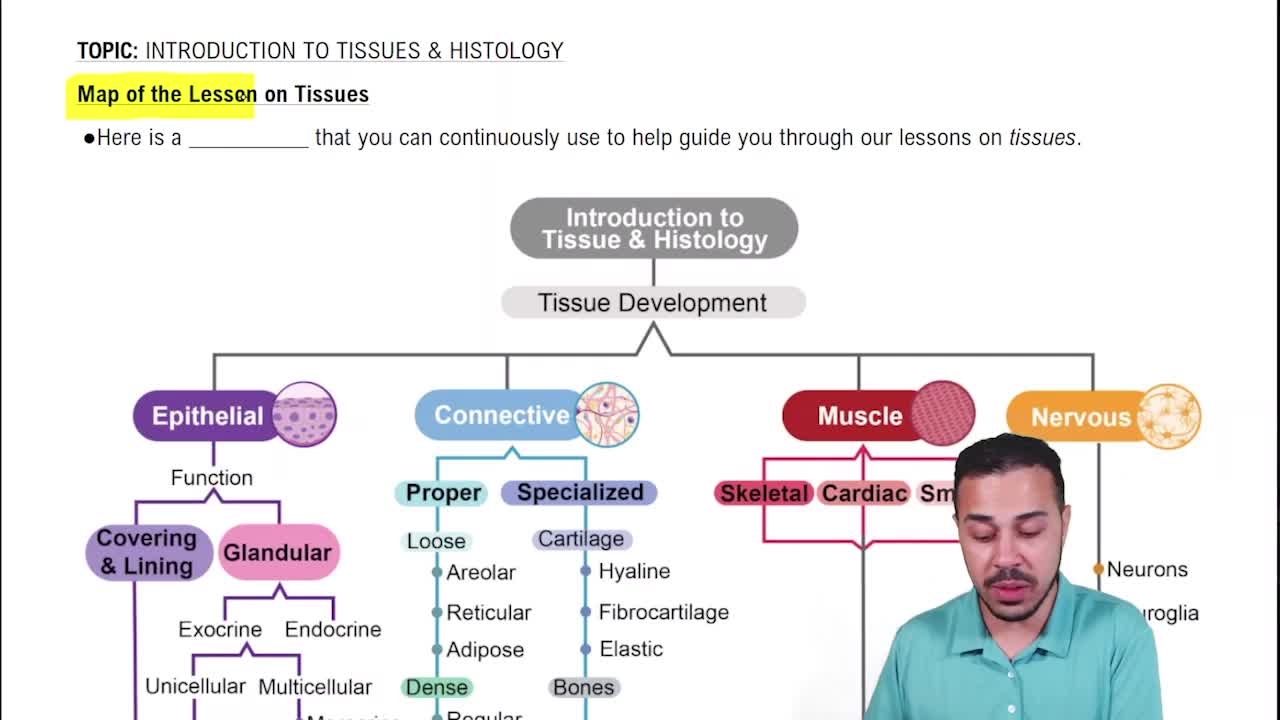
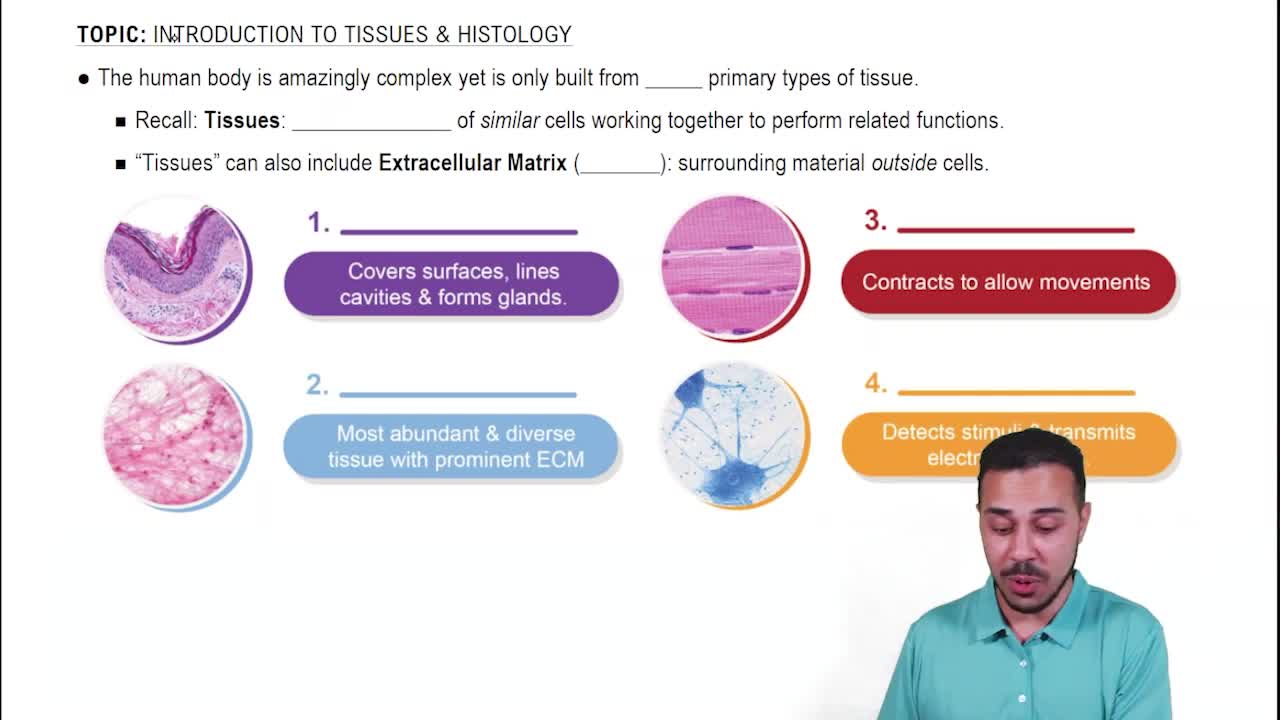
Epithelial, Connective, Muscle, and Nervous tissue.
Includes skeletal, smooth, and cardiac types; contractions produce movement.
Classified by cell shape and layers; may contain cilia or microvilli; attaches to underlying tissue with basement membrane; usually avascular.
Includes neurons and neuroglia; used to transmit signals.
Most abundant tissue; contains cells, fibers, and ground substance; used to bind structures and provide structural framework.
Transitional epithelium; allows stretching as bladder fills.
Stratified squamous epithelium; protects against abrasion.
Simple cuboidal epithelium; allows absorption and secretion.
Simple squamous epithelium; allows rapid diffusion of gases.
Stratified squamous epithelium; protects against mechanical stress.
Pseudostratified columnar epithelium; contains cilia to move mucus.
Simple squamous epithelium; facilitates exchange of materials.
Simple columnar epithelium; absorption and secretion; may have microvilli.
One layer of thin, flattened cells.
Single layer with nuclei at different levels, appears stratified; contains cilia.
Multiple layers of thin, flattened cells.
Single layer of cube-shaped cells.
Cells change shape between cuboidal and squamous.
Single layer of elongated cells with nuclei aligned; may have microvilli.
Collagen fibers arranged parallel; withstands pulling in one direction.
Loose connective tissue that binds skin to underlying organs.
Cells store triglycerides for energy; appear white.
Provides strong support and resists compression.
Contains red and white cells and platelets in a fluid matrix.
Contains osteocytes in lacunae; provides structural support.
Collagen fibers arranged irregularly; withstands pulling in many directions.
Provides delicate support with a network of fibers.
The strongest cartilage type; resists compression.
Very flexible cartilage type.
Collagen fibers provide strength; elastic fibers provide flexibility.
Ends of long bones, nose, trachea.
Dermis of skin, joint capsules.
Under skin, around organs.
Intervertebral discs, knee menisci.
Tendons and ligaments.
External ear, epiglottis.
Skeletal: multinucleated, striated, voluntary; Smooth: single nucleus, non-striated, involuntary; Cardiac: single nucleus, striated, involuntary, intercalated discs.
Exocrine glands secrete through ducts (e.g., sweat glands); endocrine glands secrete hormones into blood (e.g., thyroid gland).
Slow recovery due to poor blood supply in cartilage tissue.