 Back
BackAnatomy & Physiology: Tissue Types and Structures
 03:32
03:32
Terms in this set (21)
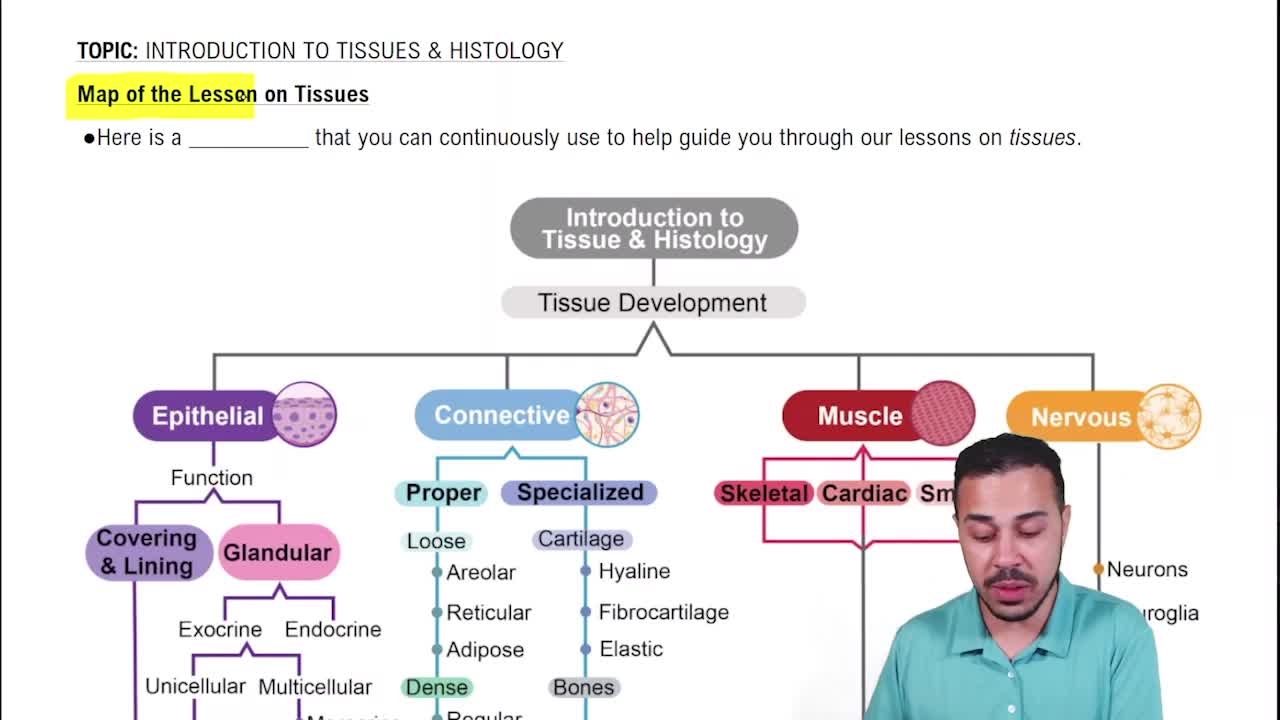
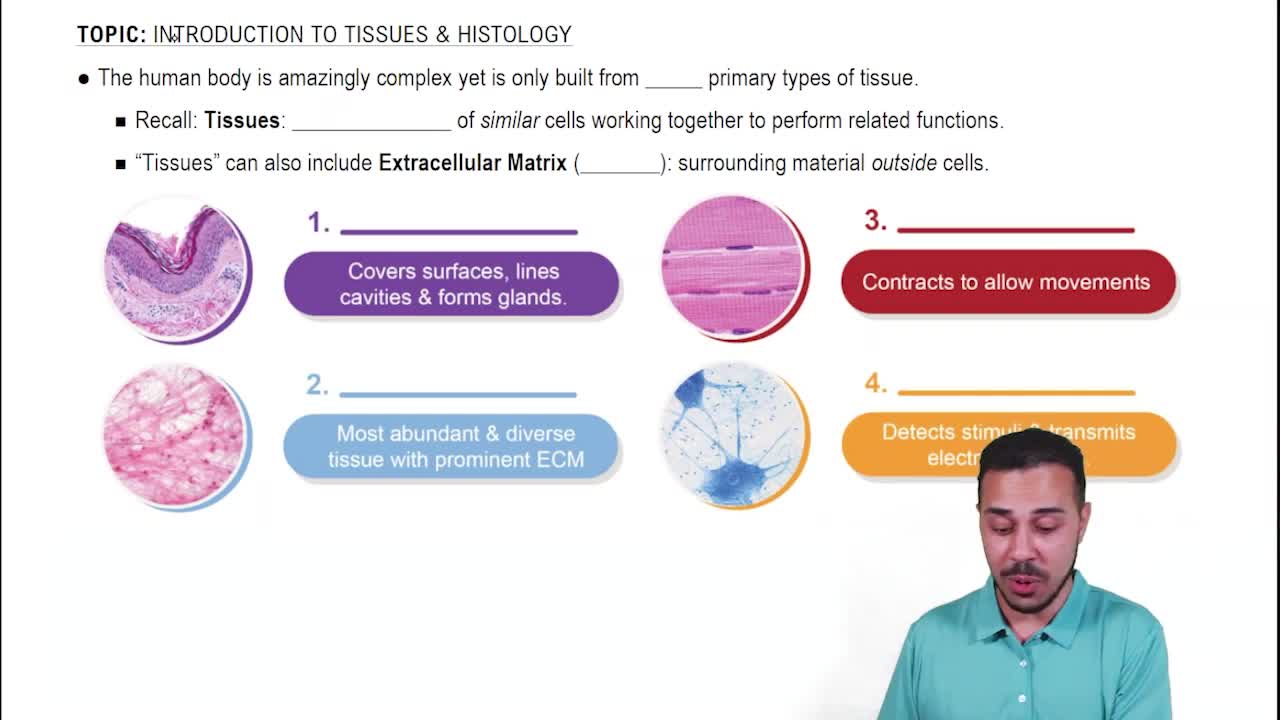
Epithelial, connective, muscle, and nervous tissues.
The extracellular matrix is a network outside cells composed of ground substance, GAGs, proteoglycans, glycoproteins, collagen, elastin, and reticular fibers that provide structural support and regulate cell behavior.
Ground substance is a gel-like material that fills space between cells and fibers, facilitating nutrient and waste exchange.
GAGs attract water to keep tissues hydrated; proteoglycans form large complexes that provide cushioning and support.
Collagen fibers provide tensile strength and resist stretching forces.
Elastin fibers allow tissues to stretch and recoil, providing elasticity, unlike collagen which resists stretch.
Reticular fibers form a delicate, supportive meshwork in soft tissues like lymph nodes and bone marrow.
Tight junctions seal cells to prevent leaks, desmosomes anchor cells for strength, and gap junctions allow communication via ion passage.
Cellularity, polarity, attachment to basement membrane, avascularity, and high regeneration capacity.
By layers: simple (one layer) or stratified (multiple layers). By shape: squamous (flat), cuboidal (cube-shaped), columnar (tall).
Found in alveoli and blood vessels, they allow rapid diffusion due to their thinness.
They provide support, protection, insulation, and transportation of substances within the body.
Loose connective tissue, dense regular, dense irregular, and reticular connective tissue.
Dense regular has parallel collagen fibers for tensile strength in one direction; dense irregular has randomly arranged fibers for strength in multiple directions.
Types include cartilage, bone, blood, and adipose tissue, each with unique structure and function.
Skeletal muscle (attached to bones), cardiac muscle (heart), and smooth muscle (walls of hollow organs).
A neuron has a cell body (soma), dendrites for receiving signals, and a single axon for transmitting impulses.
Organs are composed of multiple tissue types working together to perform specific functions.
Mucous, serous, cutaneous, and synovial membranes.
Mesothelium lines body cavities, epithelium covers body surfaces, and endothelium lines blood vessels.
Mucus is the slippery secretion; mucous describes tissues that produce mucus.