 Back
BackAnatomy & Physiology: Urinary and Reproductive Systems

 0:54
0:54
Terms in this set (27)
Filtration of blood plasma occurs in Bowman's capsule; it is the first step in urine formation.
Antidiuretic hormone (ADH) is involved; it causes water reabsorption, reducing urine volume.
Low or absent ADH leads to less water reabsorption, increasing urine volume.
One primary spermatocyte produces four spermatids after meiosis.
Primary spermatocytes have 46 chromosomes, secondary spermatocytes have 23 chromosomes, and spermatids have 23 chromosomes.
Ovaries produce oocytes, secrete inhibin, estrogen, and progesterone, and are the site of follicle development.
Sperm is made in seminiferous tubules → straight tubule → rete testis → efferent ductule → epididymis → vas deferens → ampulla → seminal gland → ejaculatory duct.
Formation of a tetrad with crossing over and synapsis of homologous chromosomes.
Urinary, digestive, integumentary, and respiratory systems also play roles in detoxification.
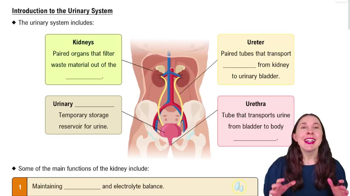
Kidneys, ureters, urinary bladder, and urethra.
ANP causes excretion of Na+ and retention of K+, leading to increased water excretion and decreased blood volume.
Excess ADH causes water retention and low urine volume; absence causes excessive urine output and dehydration risk.
It regulates blood volume and pressure by sensing sodium, chloride, and water levels and secreting renin.
It surrounds renal tubules and facilitates reabsorption and secretion between blood and filtrate.
Urochrome, a breakdown product of hemoglobin metabolism, gives urine its yellow color.
Nurse cells secrete inhibin and form the blood-testis barrier to protect developing sperm.
Oogenesis is the formation of female gametes; the second polar body is produced after fertilization to reduce chromosome number.
Semen is sperm plus fluids from the seminal vesicles, prostate gland, and Cowper's gland.
The uterus has three layers: endometrium, myometrium, and perimetrium.
Fertilization usually occurs in the ampulla of the fallopian tube.
The acrosome contains enzymes that help sperm penetrate the egg's cell membrane during fertilization.
The menstrual cycle includes the uterine cycle and the ovarian cycle, regulated by hormones.
Spermiogenesis is the final stage of sperm development where spermatids mature into motile sperm.
The spermatic cord contains the vas deferens, blood vessels, nerves, and lymphatics supplying the testes.
Defecation is the release of fecal material; urination is the release of urine.
Large proteins and blood cells should not be present in the initial filtrate.
Urea is the most abundant organic waste in urine.