 Back
BackAnatomy & Physiology: Urinary System and Kidney Function

 0:54
0:54
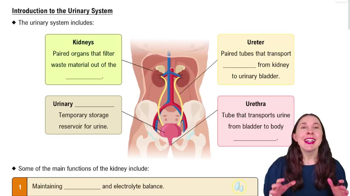
Terms in this set (28)
Herniation of the urinary bladder into the vagina, often due to tearing of pelvic floor muscles during childbirth.
Procedure using a thin viewing tube inserted through the urethra to examine the bladder’s mucosal surface.
Increased urine production caused by lack of ADH receptors in the collecting duct.
X-ray of kidneys, ureters, and bladder after intravenous injection of contrast medium.
Cluster of signs from glomerulonephritis: hematuria, mild proteinuria, hypertension, oliguria, and increased nitrogenous wastes in blood.
Severe proteinuria, edema, and lipid metabolism abnormalities caused by glomerular diseases.
Medial kidney cleft where ureter, blood vessels, lymphatics, and nerves enter and exit.
Renal fascia (anchors kidney), perirenal fat capsule (cushions kidney), fibrous capsule (prevents infection spread).
Superficial, light-colored, granular region of the kidney containing renal corpuscles.
Darker, reddish-brown region with cone-shaped renal pyramids containing urine-collecting tubules and capillaries.
Funnel-shaped pelvis collects urine from minor and major calyces and drains into ureter.
Structural and functional unit of the kidney that forms urine; consists of renal corpuscle and renal tubule.
Tuft of fenestrated capillaries in the renal corpuscle specialized for filtration.
Fenestrated endothelium, basement membrane, and podocyte foot processes with filtration slits.
Volume of filtrate formed per minute by all glomeruli; depends on net filtration pressure, surface area, and membrane permeability.
Myogenic mechanism (arteriole constriction/dilation) and tubuloglomerular feedback (macula densa sensing NaCl).
Region with macula densa, granular cells (renin-secreting), and extraglomerular mesangial cells regulating filtration and blood pressure.
Transcellular (through cells) and paracellular (between cells) pathways for reclaiming substances from filtrate.
Active transport of Na+ drives reabsorption of water and other solutes via electrochemical gradients.
Nephron loop mechanism where descending limb is permeable to water and ascending limb actively pumps out NaCl, creating medullary osmotic gradient.
Vasa recta blood flow preserves medullary osmotic gradient by passive exchange of water and solutes.
Increases water permeability in collecting ducts by inserting aquaporins, concentrating urine during dehydration.
Promotes Na+ reabsorption and K+ secretion in distal tubule and collecting duct, increasing blood volume and pressure.
Reduces Na+ reabsorption in collecting ducts, lowering blood volume and pressure.
Volume of plasma cleared of a substance per minute; used to measure kidney function and GFR.
Bladder stretch activates spinal reflex causing detrusor contraction and sphincter relaxation to void urine.
Male urethra is longer with prostatic, intermediate, and spongy parts; female urethra is shorter and opens anterior to vagina.
Horseshoe kidney, hypospadias (urethral opening on penis ventral surface), and polycystic kidney disease.