Back

Anatomy & Physiology: Urinary System and Kidney Function

Control buttons has been changed to "navigation" mode.
1/22
  • Major organs of the urinary system

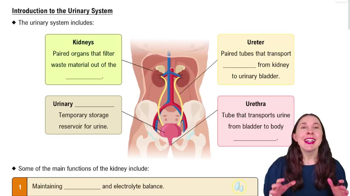
    2 kidneys (major excretory organs), 2 ureters (transport urine to bladder), 1 bladder (temporary urine storage), 1 urethra (transports urine out of body).
  • Kidney location and surface anatomy

    Retroperitoneal in superior lumbar region (~T12-L5). Right kidney lower due to liver. Adrenal gland atop each kidney. Convex lateral surface, concave medial surface with renal hilum.
  • Functions of the kidneys

    Maintain acid-base balance, fluid and electrolyte balance, blood pressure regulation, erythropoiesis stimulation, removal of toxins and nitrogenous wastes, vitamin D activation, and gluconeogenesis.
  • Layers of kidney anatomy

    Outer: renal fascia, perirenal fat capsule, fibrous capsule. Inner: renal cortex (granular), renal medulla (renal pyramids), renal columns, renal pelvis.
  • Urine flow pathway

    Renal pyramid → minor calyx → major calyx → renal pelvis → ureter → bladder → urethra → outside body.
  • Blood supply to kidneys

    Renal arteries deliver ~25% cardiac output. Blood flows: aorta → renal artery → segmental → interlobar → arcuate → cortical radiate → afferent arteriole → glomerulus → efferent arteriole → peritubular capillaries/vasa recta → veins → inferior vena cava.
  • Nitrogenous wastes excreted by kidneys

    Urea (from protein metabolism), uric acid (nucleic acid catabolism), creatinine (creatine phosphate catabolism).
  • Nephron structure and function

    Functional unit of kidney (~1 million/kidney). Composed of renal corpuscle (glomerulus + Bowman's capsule) and renal tubule (PCT, nephron loop, DCT).
  • Glomerulus and Bowman's capsule

    Glomerulus: fenestrated capillaries for filtration. Bowman's capsule: parietal layer (simple squamous), visceral layer (podocytes with filtration slits).
  • Major processes of urine formation

    1. Filtration (passive), 2. Reabsorption (active), 3. Secretion (active).
  • Types of nephrons

    Cortical nephrons (~85%): mostly cortex. Juxtamedullary nephrons: long loops in medulla, important for concentrated urine.
  • Juxtaglomerular complex components

    Macula densa (chemoreceptors sensing NaCl), granular (JG) cells (renin secretion, mechanoreceptors), mesangial cells (signal transmission).
  • Forces affecting glomerular filtration

    Outward: glomerular hydrostatic pressure (55 mmHg). Inward: capsular hydrostatic pressure (15 mmHg), glomerular colloid osmotic pressure (30 mmHg). Net filtration pressure = 55 - (15 + 30) = 10 mmHg.
  • Glomerular filtration rate (GFR) regulation

    Controlled by net filtration pressure, surface area, and membrane permeability. Intrinsic (myogenic and tubuloglomerular feedback) and extrinsic (SNS, hormones) controls maintain GFR.
  • Tubular reabsorption routes

    Transcellular: through cells. Paracellular: between cells via tight junctions (leaky in proximal tubule).
  • Role of Na+ in tubular reabsorption

    Na+ active transport via Na+/K+ ATPase drives reabsorption of nutrients, ions, and water by creating concentration gradients.
  • Hormonal regulation of reabsorption

    ADH increases water reabsorption via aquaporins. Aldosterone promotes Na+ reabsorption and K+ secretion. ANP decreases Na+ reabsorption. PTH increases Ca2+ reabsorption.
  • Countercurrent multiplier mechanism

    Opposite flow in nephron loop limbs creates osmotic gradient. Descending limb permeable to water; ascending limb actively pumps out Na+ and Cl-, impermeable to water.
  • Countercurrent exchange in vasa recta

    Blood flows opposite in ascending and descending limbs, preserving medullary osmotic gradient and removing reabsorbed water.
  • Renal clearance formula

    C = UV/P, where C = clearance rate (ml/min), U = urine concentration, V = urine flow rate, P = plasma concentration.
  • Micturition reflex control

    Bladder stretch receptors activate parasympathetic neurons causing detrusor contraction and internal sphincter relaxation; somatic motor neurons control external sphincter.
  • Common renal pathologies

    Proteinuria (protein in urine), glomerulonephritis (inflammation), pyelonephritis (kidney infection), renal calculi (kidney stones), renal failure (GFR < 15 ml/min).