Skip to main content
Anatomy & Physiology
My Course
Learn
Exam Prep
AI Tutor
Study Guides
Textbook Solutions
Flashcards
Explore
Try the app
My Course
Learn
Exam Prep
AI Tutor
Study Guides
Textbook Solutions
Flashcards
Explore
Try the app
Back
Anatomy & Physiology: Urinary System and Renal Physiology
You can tap to flip the card.
Primary functions of the urinary system
You can tap to flip the card.
👆
Primary functions of the urinary system
Excretion
of organic wastes,
elimination
of waste products, and
homeostatic regulation
of blood plasma volume and solute concentration.
Track progress
Control buttons has been changed to "navigation" mode.
1/27
Recommended videos
0:54
Introduction to the Urinary System Example 1
5680
views
155
rank
2:57
The Urinary System
7614
views
225
rank
2
comments
Terms in this set (27)
Hide definitions
Primary functions of the urinary system
Excretion
of organic wastes,
elimination
of waste products, and
homeostatic regulation
of blood plasma volume and solute concentration.
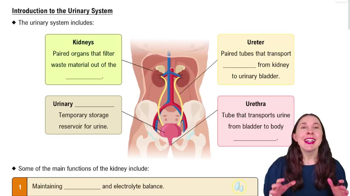
Organs of the urinary system
Kidneys (produce urine), ureters (paired tubes), urinary bladder (muscular sac), and urethra (exit tube).
Four homeostatic functions of the urinary system
1. Regulates blood volume and pressure, 2. Regulates plasma ion concentrations, 3. Stabilizes blood pH, 4. Conserves valuable nutrients.
Location and size of typical adult kidney
Located on either side of vertebral column; about 10 cm long, 5.5 cm wide, 3 cm thick; weighs ~150 g.
Renal cortex and medulla
Renal cortex is the superficial, reddish-brown granular layer; renal medulla contains 6-18 renal pyramids separated by renal columns.
Nephron structure
Consists of renal corpuscle (glomerulus and Bowman's capsule) and renal tubule (PCT, loop of Henle, DCT).
Functions of the renal tubule
1. Reabsorb useful organic nutrients, 2. Reabsorb over 90% of water, 3. Secrete waste products missed by filtration.
Difference between cortical and juxtamedullary nephrons
Cortical nephrons have short loops mostly in cortex; juxtamedullary nephrons have long loops extending deep into medulla.
Role of the juxtaglomerular complex (JGC)
Endocrine structure that secretes erythropoietin and renin; formed by macula densa and juxtaglomerular cells.
Three basic processes of urine formation
Filtration
,
reabsorption
, and
secretion
.
Filtration at the glomerulus
Hydrostatic pressure forces water and small solutes through capillary pores; larger solutes and cells are retained.
Functions of the proximal convoluted tubule (PCT)
Reabsorbs organic nutrients, ions, water; secretes wastes; reabsorbs 60-70% of filtrate volume.
Role of aldosterone in the kidney
Hormone from adrenal cortex that stimulates Na+ pumps and channels in DCT and collecting duct, reducing Na+ loss in urine.
Effect of antidiuretic hormone (ADH) on urine concentration
Increases water permeability in DCT and collecting ducts by adding water channels, concentrating urine.
Normal composition of urine
Clear, sterile solution with yellow pigment urobilin; contains dissolved nitrogenous wastes like urea, creatinine, uric acid.
Autoregulation of glomerular filtration rate (GFR)
Maintains stable GFR by adjusting diameters of afferent and efferent arterioles and glomerular capillaries.
Renin–angiotensin system effects
Renin release triggers angiotensin II formation, causing vasoconstriction, aldosterone secretion, ADH release, and increased thirst.
Role of atrial natriuretic peptides (ANP and BNP)
Released by heart to dilate afferent arterioles, constrict efferent arterioles, increasing GFR and promoting sodium and water loss.
Micturition reflex
Stretch receptors in bladder activate parasympathetic neurons causing detrusor muscle contraction and relaxation of urethral sphincters.
Fluid balance in the body
Balance between water gained (eating, drinking, metabolism) and lost (urine, feces, perspiration); regulated by kidneys and hormones.
Electrolyte balance importance
Maintains equal gains and losses of ions; sodium and potassium balance critical for cell function and fluid distribution.
Acid–base balance role of kidneys
Secrete hydrogen ions, reabsorb bicarbonate, and generate buffers to maintain blood pH between 7.35 and 7.45.
Carbonic acid–bicarbonate buffer system
Most important ECF buffer; carbonic acid dissociates into H+ and bicarbonate to stabilize pH; depends on respiratory function.
Respiratory compensation in acid–base balance
Adjusts pH by changing respiration rate to alter CO2 levels, which shifts carbonic acid equilibrium.
Renal compensation in acid–base balance
Adjusts secretion or reabsorption of H+ and HCO3- in response to plasma pH changes to maintain homeostasis.
Common acid–base disorders
Acidosis
(pH <7.35) and
alkalosis
(pH >7.45), affecting nervous and cardiovascular systems.
Age-related changes in urinary system
Decline in nephron number, reduced GFR, decreased ADH sensitivity, and impaired micturition reflex causing incontinence or retention.
 BackBack
 0:54
0:54