Skip to main content
Anatomy & Physiology
My Course
Learn
Exam Prep
AI Tutor
Study Guides
Textbook Solutions
Flashcards
Explore
Try the app
My Course
Learn
Exam Prep
AI Tutor
Study Guides
Textbook Solutions
Flashcards
Explore
Try the app
Back
anatomy lecture 4
You can tap to flip the card.
What is the chromosome composition after DNA replication in G2 phase?
You can tap to flip the card.
👆
What is the chromosome composition after DNA replication in G2 phase?
46 chromosomes, each with 2 sister chromatids, totaling 92 chromatids.
Track progress
Control buttons has been changed to "navigation" mode.
1/28
Recommended videos
Guided course
04:44
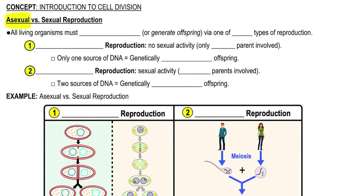
Asexual vs. Sexual Reproduction
18555
views
391
rank
Guided course
09:40
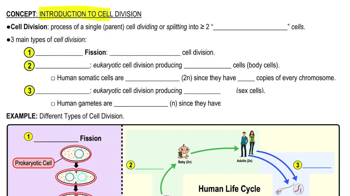
Introduction to Cell Division
28187
views
637
rank
1
comments
Guided course
03:18
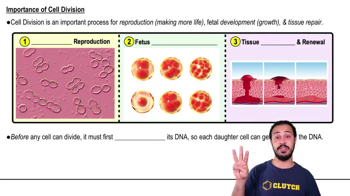
Importance of Cell Division
17764
views
573
rank
Terms in this set (28)
Hide definitions
What is the chromosome composition after DNA replication in G2 phase?
46 chromosomes, each with 2 sister chromatids, totaling 92 chromatids.
What occurs during the G2 phase of the cell cycle?
Growth and metabolism with production of enzymes and proteins needed for cell division; centrosome replication completes.
What are the four phases of mitosis in order?
Prophase, Metaphase, Anaphase, Telophase (PMAT).
What happens during prophase of mitosis?
Chromosomes condense and become visible; centrosomes move to opposite poles; spindle microtubules attach to kinetochores.
Describe the metaphase stage of mitosis.
Chromosomes line up single file along the cell equator, organized by the spindle apparatus.
What key event occurs during anaphase of mitosis?
Sister chromatids separate as spindle microtubules shorten, pulling chromatids to opposite poles; cytokinesis begins.
What occurs during telophase of mitosis?
Chromosomes uncoil into chromatin; nuclear envelope and nucleoli reappear; spindle disassembles; cytokinesis completes.
What is cytokinesis?
Division of the cytoplasm that usually begins in anaphase and completes after telophase.
What is the result of mitosis and cytokinesis?
Two diploid daughter cells identical to the original cell.
What is the purpose of meiosis?
To produce haploid gametes (sperm and ova) with genetic variation.
How many genetically unique gametes are produced from one cell by meiosis?
Four genetically unique gametes.
What happens during prophase I of meiosis that differs from mitosis?
Homologous chromosomes pair to form tetrads, allowing crossing over and genetic recombination.
Describe metaphase I of meiosis.
23 tetrads line up along the cell equator.
What occurs during anaphase I of meiosis?
Homologous chromosomes separate and move to opposite poles; sister chromatids remain attached.
How does meiosis II differ from mitosis?
It starts with haploid cells (23 chromosomes) and separates sister chromatids like mitosis.
What is the chromosome number change during meiosis I?
From diploid (2n) to haploid (n).
What is a zygote?
A diploid (2n) cell formed by the fusion of haploid sperm and egg.
What are the stages of the pre-embryonic period?
Fertilization, cleavage divisions forming morula, blastocyst formation, and implantation.
What is a morula?
A solid ball of 16-32 cells formed about 72 hours after fertilization, same size as the zygote.
What are the main parts of the blastocyst?
Blastocoel (fluid cavity), embryoblast (inner cell mass), and trophoblast (outer layer forming chorion).
What is the role of the trophoblast?
Forms the chorion, which provides nutrients to the developing embryo and contributes to placenta formation.
What are the two layers of the bilaminar embryonic disc?
Epiblast (upper layer) and hypoblast (lower layer).
What germ layers form from the epiblast?
Ectoderm, mesoderm, and endoderm.
What does the ectoderm form?
Nervous system and epidermis of the skin.
What does the mesoderm form?
Muscles, cardiovascular system, dermis, and most bones.
What does the endoderm form?
Epithelial lining of digestive, respiratory, urinary, and reproductive systems and their glands.
What is the chorion and its function?
An extraembryonic membrane derived from trophoblast cells; forms chorionic villi for nutrient and gas exchange in the placenta.
What occurs during the fetal period?
Growth and maturation of organs from the 9th week to birth (around 40 weeks).
 BackBack
 04:44