 Back
Anatomy Unit 4
 04:44

Terms in this set (31)
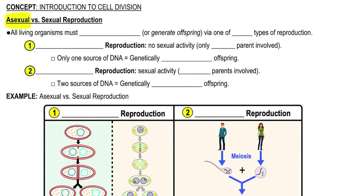
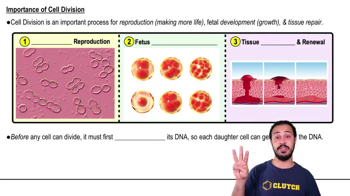
For growth, repair, replacement of old or dead cells, production of new cells, production of gametes, and specialization of cells.
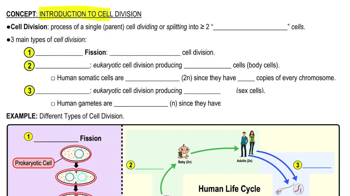
Mitosis (growth, repair, replacement) and Meiosis (production of gametes).
46 chromosomes arranged in 23 pairs; these cells are diploid (2n).
Cells with one copy of each chromosome (n), such as human gametes with 23 chromosomes.
Chromosome pairs of similar size and shape carrying the same genes but possibly different alleles, one from each parent.
Gene: DNA region coding for a product.
Allele: Different versions of a gene.
Locus: Specific gene location on a chromosome.
Pairs 1–22 are autosomes (body traits), pair 23 are sex chromosomes (XX or XY).
A reproductive cell (sperm or egg) that is haploid with 23 chromosomes.
Sperm (n=23) and egg (n=23) combine to form a diploid zygote (2n=46).
Interphase (G1, S, G2) and Mitotic phase (mitosis + cytokinesis).
DNA replication; each chromosome duplicates to form two identical sister chromatids.
Two identical copies of a chromosome connected at the centromere after DNA replication.
Before replication: 1 chromosome = 1 chromatid.
After replication: 1 chromosome = 2 sister chromatids.
Separated chromatids become individual chromosomes.
A resting, non-dividing state where cells remain alive but do not prepare to divide (e.g., neurons, cardiac muscle cells).
Nuclear division producing 2 genetically identical diploid cells for growth, repair, and replacement.
Prophase, Metaphase, Anaphase, Telophase.
Chromatin condenses into chromosomes, nuclear envelope breaks down, spindle forms, nucleolus disappears.
Spindle microtubules move chromosomes by attaching to kinetochores at the centromere.
Chromosomes line up at the metaphase plate (middle of the cell).
Sister chromatids separate and move to opposite poles of the cell.
Chromosomes reach poles, uncoil, nuclear envelopes reform, nucleoli reappear, spindle fibers disappear.
Division of the cytoplasm, physically splitting one cell into two genetically identical diploid cells.
Special cell division producing 4 genetically different haploid gametes to maintain chromosome number across generations.
To reduce chromosome number by half so fertilization restores diploid number, preventing chromosome doubling each generation.
Two divisions: Meiosis I and Meiosis II, with DNA replication only before Meiosis I.
Homologous chromosomes separate; this is called reduction division (diploid to haploid).
A paired set of homologous chromosomes, each with two sister chromatids, totaling four chromatids.
Exchange of DNA between homologous chromosomes during Prophase I, increasing genetic variation.
Metaphase I: homologous pairs line up.
Metaphase II: individual chromosomes line up.
Anaphase I: homologous chromosomes separate.
Anaphase II: sister chromatids separate.
One diploid cell produces four genetically different haploid cells (gametes) with 23 chromosomes each.