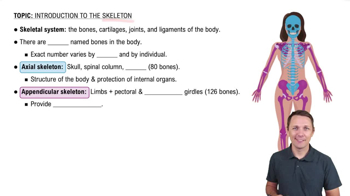
The appendicular skeleton consists of 126 bones that allow movement and manipulation of objects. It includes all bones besides the axial skeleton, such as limbs and supportive girdles.
What bones make up the pectoral girdle?
The pectoral girdle consists of two clavicles (collarbones) and two scapulae (shoulder blades).
What is the function of the pectoral girdle?
It connects the arms to the body, positions the shoulders, and provides a base for arm movement.
Where does the pectoral girdle connect to the axial skeleton?
The only direct articulation is at the manubrium of the sternum via the sternal end of the clavicle.
Describe the clavicle.
The clavicle is a long, S-shaped bone that articulates medially with the sternum and laterally with the scapula at the acromion.
What are the three borders of the scapula?
The scapula has a superior border, a medial (vertebral) border, and a lateral (axillary) border.
What is the glenoid cavity of the scapula?
The glenoid cavity is the lateral angle of the scapula that articulates with the humerus to form the shoulder joint.
Name the two processes around the glenoid cavity.
The coracoid process (smaller, anterior) and the acromion (larger, posterior) which articulates with the clavicle.
What are the major features of the humerus proximal epiphysis?
It includes the head, greater tubercle (lateral), lesser tubercle (anterior, medial), and the intertubercular groove between tubercles.
What articulations are found at the distal end of the humerus?
The capitulum articulates with the radius, and the trochlea articulates with the ulna.
What are the major fossae on the humerus and their functions?
Olecranon fossa (posterior, for olecranon of ulna), coronoid fossa (anterior, for coronoid process of ulna), and radial fossa (anterior, for head of radius).
What bones make up the forearm?
The forearm consists of two long bones: the ulna (medial) and the radius (lateral).
Describe the olecranon of the ulna.
The olecranon is the superior end of the ulna, forming the point of the elbow and the superior lip of the trochlear notch.
What is the interosseous membrane?
A fibrous sheet connecting the lateral margin of the ulna shaft to the radius, stabilizing the two bones.
What is the function of the radial head?
The disk-shaped radial head articulates with the capitulum of the humerus and allows rotation of the forearm.
How many carpal bones are in the wrist and how are they arranged?
There are eight carpal bones arranged in two rows: four proximal and four distal bones.
Name the four proximal carpal bones.
Scaphoid, lunate, triquetrum, and pisiform.
Name the four distal carpal bones.
Trapezium, trapezoid, capitate, and hamate.
What bones form the pelvic girdle?
The pelvic girdle is made up of two coxal (hip) bones, each formed by the fusion of the ilium, ischium, and pubis.
What is the acetabulum?
The acetabulum is the hip socket on the lateral surface of the coxal bone where the ilium, ischium, and pubis meet; it articulates with the femoral head.
What are the major features of the ilium?
The ilium includes the iliac crest (upper brim), iliac fossa, and the greater sciatic notch for the sciatic nerve.
What are the key landmarks of the ischium?
Ischial spine, ischial tuberosity (the part you sit on), and ischial ramus.
What is the pubic symphysis?
The pubic symphysis is the joint where the two pubic bones meet, connected by a pad of fibrocartilage.
What bones make up the lower limbs?
The lower limbs include the femur, patella, tibia, fibula, tarsals, metatarsals, and phalanges.
What is the fovea capitis on the femur?
A small pit on the femoral head where a ligament attaches to the acetabulum.
What is the function of the patella?
The patella protects the knee joint and is formed within the tendon of the quadriceps femoris muscle.
What are the major features of the tibia?
The tibia supports body weight, has medial and lateral condyles that articulate with the femur, and a tibial tuberosity for patellar ligament attachment.
What is the role of the fibula?
The fibula is a smaller, lateral bone of the leg that provides muscle attachment and lateral stability to the ankle.
What bones form the ankle (tarsals)?
The ankle consists of seven tarsal bones including the talus, calcaneus, navicular, cuboid, and three cuneiform bones.
 Back
 4:50
