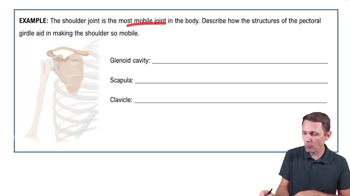
The clavicle and the scapula form the pectoral girdle, attaching the upper limbs to the trunk.
How does the pectoral girdle attach to the axial skeleton?
Only the clavicle articulates with the axial skeleton at its medial end with the manubrium and first rib.
What is the function of the pectoral girdle?
It provides attachment for muscles that move the upper limb and allows high mobility but less stability due to a shallow glenoid cavity.
Name the three borders of the scapula.
The scapula has three borders: superior, medial (vertebral), and lateral (axillary).
What are the three angles of the scapula?
The scapula has three angles: superior, lateral, and inferior.
What two joints comprise the shoulder joint?
The shoulder joint consists of the glenohumeral joint (ball-and-socket between glenoid cavity and humerus) and the acromioclavicular joint (between clavicle and acromion).
What is a common injury to the glenohumeral joint?
A dislocation occurs when the head of the humerus slips out of the glenoid fossa.
What bones form the upper limb?
The upper limb consists of 30 bones grouped into the arm (humerus), forearm (radius and ulna), and hand (carpals, metacarpals, phalanges).
What is the only bone in the arm?
The humerus is the single bone of the arm, articulating proximally with the scapula and distally with the radius and ulna.
Which bone primarily forms the elbow joint?
The ulna forms the main part of the elbow joint with the humerus, acting as a hinge.
What is the role of the radius in forearm movement?
The radius allows rotation of the forearm and hand, articulating with the humerus and carpals.
How many carpal bones are there and how are they arranged?
There are eight carpal bones arranged in two rows: proximal (scaphoid, lunate, triquetrum, pisiform) and distal (trapezium, trapezoid, capitate, hamate).
What bones form the pelvic girdle?
The pelvic girdle consists of paired coxal bones (ilium, ischium, pubis) that unite anteriorly at the pubic symphysis and articulate posteriorly with the sacrum.
What is the acetabulum?
The acetabulum is a deep cup-shaped socket on the lateral pelvic surface that forms the hip joint with the femoral head.
What are the major differences between male and female pelves?
The female pelvis is lighter, wider, and shallower to accommodate childbirth, providing more room in the true pelvis compared to the male pelvis.
What is the largest and strongest bone in the body?
The femur is the longest and strongest bone, forming the thigh and articulating with the acetabulum and tibia.
What is the function of the patella?
The patella is a sesamoid bone embedded in the quadriceps tendon that protects the knee and improves leverage of thigh muscles.
Which bones form the leg?
The leg is formed by the tibia (medial, weight-bearing) and the fibula (lateral, stabilizes ankle).
What bones compose the foot?
The foot consists of the tarsus (ankle), metatarsus (foot), and phalanges (toes).
What are the three arches of the foot?
The foot has three arches: medial longitudinal, lateral longitudinal, and transverse, maintained by bone shapes, ligaments, and tendons.
 Back
Back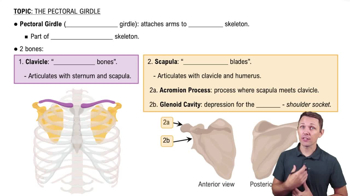
 6:23
6:23