Skip to main content
Anatomy & Physiology
My Course
Learn
Exam Prep
AI Tutor
Study Guides
Textbook Solutions
Flashcards
Explore
Try the app
My Course
Learn
Exam Prep
AI Tutor
Study Guides
Textbook Solutions
Flashcards
Explore
Try the app
Back
Appendicular Skeleton: Pectoral and Pelvic Girdles & Limbs
You can tap to flip the card.
Axial skeleton
You can tap to flip the card.
👆
Axial skeleton
The part of the skeleton consisting of the skull, vertebral column, and rib cage.
Track progress
Control buttons has been changed to "navigation" mode.
1/20
Recommended videos
Guided course
4:50
Skeletal System
13526
views
450
rank
Terms in this set (20)
Hide definitions
Axial skeleton
The part of the skeleton consisting of the skull, vertebral column, and rib cage.
Appendicular skeleton
The part of the skeleton that includes the pectoral girdle, pelvic girdle, and the bones of the upper and lower limbs.
Bones of the pectoral girdle
The clavicle and scapula form the pectoral girdle.
Function of the pectoral girdle
Supports the upper limbs and provides attachment points for muscles that move the arms.
Articulation of pectoral girdle bones
The clavicle articulates medially with the sternum and laterally with the scapula; the scapula does not directly articulate with the axial skeleton.
Major bone markings of the clavicle
Includes the sternal end, acromial end, and the conoid tubercle.
Major bone markings of the scapula
Includes the spine, acromion, coracoid process, and glenoid cavity.
Bones of the upper limb
Includes the humerus (arm), radius and ulna (forearm), carpals (wrist), metacarpals, and phalanges (hand).
Pelvic girdle bones
Formed by two hip bones (coxal bones), each consisting of the ilium, ischium, and pubis.
Articulations of the pelvic girdle
The two hip bones articulate anteriorly at the pubic symphysis and posteriorly with the sacrum at the sacroiliac joints.
Functions of the pelvic girdle
Supports the weight of the upper body, protects pelvic organs, and provides attachment for lower limbs.
Major bone markings of the ilium
Includes the iliac crest, anterior superior iliac spine, and greater sciatic notch.
Major bone markings of the ischium
Includes the ischial tuberosity and ischial spine.
Major bone markings of the pubis
Includes the pubic symphysis and pubic arch.
Differences between male and female pelves
Female pelvis is wider, shallower, and has a larger pelvic inlet and outlet for childbirth.
Bones of the thigh
The femur is the single bone of the thigh.
Bones of the leg
Includes the tibia (medial) and fibula (lateral).
Bones of the foot
Includes tarsals (ankle), metatarsals, and phalanges (toes).
Articulations of the upper limb
Includes the shoulder joint (glenohumeral), elbow joint, wrist joints, and finger joints.
Articulations of the lower limb
Includes the hip joint, knee joint, ankle joint, and toe joints.
 BackBack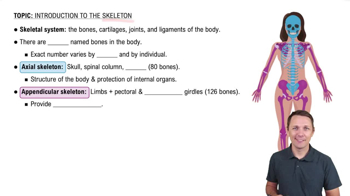
 4:50
4:50