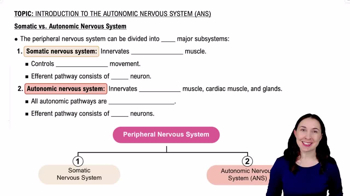
The ANS is the involuntary arm of the peripheral nervous system that controls vital functions like heart rate, blood pressure, digestion, and urinary processes without conscious control.
What are the two main divisions of the ANS?
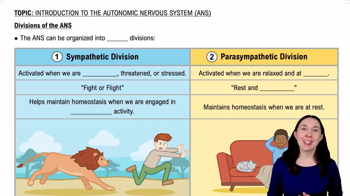
The ANS is divided into the sympathetic and parasympathetic nervous systems, which work together to maintain homeostasis.
How do somatic and autonomic motor divisions differ?
Somatic motor neurons innervate skeletal muscle directly, while autonomic motor neurons innervate smooth muscle, cardiac muscle, and glands via a two-neuron circuit.
What are the two neurons in the autonomic motor pathway?
Preganglionic neuron (cell body in CNS, releases acetylcholine) and postganglionic neuron (cell body in autonomic ganglion, releases acetylcholine or norepinephrine).
What is the role of the sympathetic nervous system?
Known as the 'fight or flight' system, it prepares the body for emergencies by increasing heart rate, dilating pupils, and redirecting blood flow to muscles.
Where are sympathetic chain ganglia located?
They run parallel to the vertebral column on both sides and contain most postganglionic sympathetic neuron cell bodies.
What neurotransmitter do sympathetic preganglionic neurons release?
Acetylcholine (ACh) is released at synapses with postganglionic neurons.
What neurotransmitters do sympathetic postganglionic neurons release at target cells?
They release acetylcholine, epinephrine, or norepinephrine depending on the target tissue.
What are adrenergic receptors?
Receptors that bind epinephrine and norepinephrine, including Alpha-1, Alpha-2, Beta-1, Beta-2, and Beta-3 types.
What are cholinergic receptors in the sympathetic system?
Receptors that bind acetylcholine, including muscarinic and nicotinic receptors.
What is the parasympathetic nervous system also called?
The 'rest and digest' system or craniosacral division, associated with cranial and sacral nerves.
What neurotransmitter is released by parasympathetic neurons?
Both preganglionic and postganglionic parasympathetic neurons release acetylcholine.
What receptors are involved in parasympathetic signaling?
Nicotinic receptors on postganglionic neurons and muscarinic receptors on parasympathetic target cells.
What are some effects of parasympathetic activation?
Decreased heart rate and blood pressure, pupil constriction, and lens accommodation for near vision.
How do sympathetic and parasympathetic divisions interact?
They often have antagonistic effects on the same organs to maintain homeostasis through dual innervation.
What is the function of the sympathetic chain ganglia?
They serve as relay points where preganglionic neurons synapse with postganglionic neurons that innervate target tissues.
What is the role of white and gray rami communicantes?
White rami carry myelinated preganglionic sympathetic axons to the chain ganglia; gray rami carry unmyelinated postganglionic axons back to spinal nerves.
What is the enteric nervous system?
A local autonomic system regulating digestive tract motility and secretion, capable of reflexes independent of the CNS.
What are common pharmacological targets in the sympathetic nervous system?
Drugs acting as antagonists or agonists on alpha and beta adrenergic receptors, used to treat conditions like asthma and hypertension.
What is the significance of the adrenal medulla in the sympathetic system?
It acts as a modified postganglionic neuron releasing epinephrine and norepinephrine into the bloodstream during sympathetic activation.
 Back
Back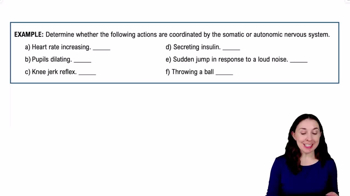
 1:10
1:10