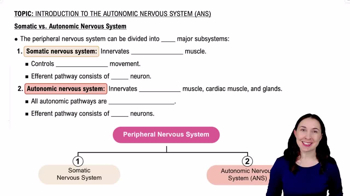
What is the main difference between the somatic nervous system and the autonomic nervous system in terms of effectors?
The somatic nervous system innervates skeletal muscle, while the autonomic nervous system innervates smooth muscle, cardiac muscle, and glands.
How many motor neurons are involved in the autonomic nervous system pathway?
The autonomic nervous system uses a two-neuron chain: a preganglionic neuron and a postganglionic neuron.
What neurotransmitters are released by preganglionic and postganglionic fibers in the ANS?
Preganglionic fibers release acetylcholine (ACh). Postganglionic fibers release norepinephrine (NE) in most sympathetic fibers and ACh in most parasympathetic fibers.
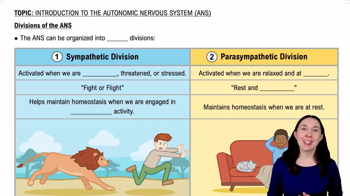
What are the two main divisions of the autonomic nervous system and their general functions?
The sympathetic division mobilizes the body during activity ('fight or flight'), and the parasympathetic division promotes maintenance functions and conserves energy ('rest and digest').
Where do parasympathetic fibers originate compared to sympathetic fibers?
Parasympathetic fibers originate in the craniosacral regions (brain and sacral spinal cord), while sympathetic fibers originate in the thoracolumbar regions (thoracic and lumbar spinal cord).
Describe the relative lengths of preganglionic and postganglionic fibers in the parasympathetic and sympathetic divisions.
Parasympathetic division has long preganglionic and short postganglionic fibers; sympathetic division has short preganglionic and long postganglionic fibers.
Where are parasympathetic ganglia located compared to sympathetic ganglia?
Parasympathetic ganglia are located in or near the target organs, while sympathetic ganglia lie close to the spinal cord.
Which cranial nerve accounts for about 90% of all parasympathetic preganglionic fibers?
The vagus nerve (cranial nerve X) accounts for approximately 90% of parasympathetic preganglionic fibers.
What is the role of the adrenal medulla in the sympathetic nervous system?
Some sympathetic preganglionic fibers pass directly to the adrenal medulla, stimulating it to secrete epinephrine and norepinephrine into the blood, prolonging sympathetic effects.
What are the two types of cholinergic receptors and where are they found?
Nicotinic receptors are found on all postganglionic neurons and adrenal medulla cells; muscarinic receptors are found on all effector cells stimulated by postganglionic cholinergic fibers.
What is the effect of acetylcholine on nicotinic receptors?
ACh binding to nicotinic receptors is always excitatory, opening ion channels and depolarizing the postsynaptic cell.
How do muscarinic receptors respond to acetylcholine?
ACh binding to muscarinic receptors can be excitatory or inhibitory, depending on the receptor subtype and target organ.
What are the two major classes of adrenergic receptors and their subclasses?
Adrenergic receptors include alpha (α1, α2) and beta (β1, β2, β3) receptors, which respond to norepinephrine or epinephrine.
What is meant by dual innervation in the autonomic nervous system?
Dual innervation means most visceral organs receive input from both sympathetic and parasympathetic divisions, often producing opposing effects.
What is sympathetic tone and its role in blood vessel regulation?
Sympathetic tone is the continual partial constriction of blood vessels by sympathetic fibers, regulating blood pressure by adjusting vessel diameter.
How do the parasympathetic and sympathetic divisions differ in the duration and localization of their effects?
Parasympathetic effects are short-lived and localized due to rapid ACh removal; sympathetic effects are longer-lasting and diffuse due to slower NE inactivation and adrenal hormone release.
Which brain region is the main integration center for autonomic nervous system activity?
The hypothalamus is the primary integration center for ANS activity, regulating heart rate, blood pressure, temperature, and emotional responses.
What are visceral reflex arcs and how do they differ from somatic reflex arcs?
Visceral reflex arcs involve two motor neurons (preganglionic and postganglionic), use visceral sensory neurons, and have effectors like smooth muscle, cardiac muscle, and glands, unlike somatic reflexes.
Name a common disorder of the autonomic nervous system related to overactive sympathetic vasoconstriction.
Hypertension is caused by an overactive sympathetic vasoconstrictor response, leading to high blood pressure and increased cardiac workload.
What is autonomic dysreflexia and who is most at risk?
Autonomic dysreflexia is a life-threatening uncontrolled activation of autonomic neurons, mainly affecting people with spinal cord injuries above T6, causing dangerously high blood pressure.
 Back
Back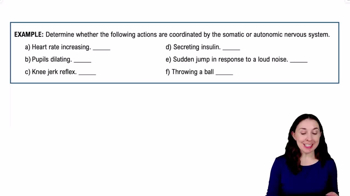
 1:10
1:10