Skip to main content
Anatomy & Physiology
My Course
Learn
Exam Prep
AI Tutor
Study Guides
Textbook Solutions
Flashcards
Explore
Try the app
My Course
Learn
Exam Prep
AI Tutor
Study Guides
Textbook Solutions
Flashcards
Explore
Try the app
Back
Autonomic Nervous System and Memory - Anatomy & Physiology
You can tap to flip the card.
What is the somatic nervous system (SNS)?
You can tap to flip the card.
👆
What is the somatic nervous system (SNS)?
SNS
controls
voluntary
movements of skeletal muscles.
Track progress
Control buttons has been changed to "navigation" mode.
1/66
Recommended videos
1:10
Introduction to the Autonomic Nervous System Example 1
7800
views
172
rank
1:50
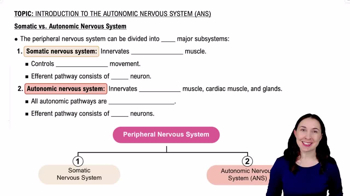
Somatic vs. Autonomic Nervous System
10394
views
208
rank
3:10
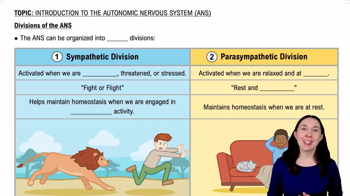
Divisions of the ANS
8707
views
138
rank
Terms in this set (66)
Hide definitions
What is the somatic nervous system (SNS)?
SNS
controls
voluntary
movements of skeletal muscles.
What is the autonomic nervous system (ANS)?
ANS
controls
involuntary
actions of visceral effectors like smooth muscle, glands, and cardiac muscle.
Does the SNS require conscious awareness?
Yes
, SNS actions are under
conscious control
.
Does the ANS require conscious awareness?
No
, ANS actions occur
without conscious control
.
What controls ANS activity?
The
hypothalamus
is the main control center for the ANS.
What is a preganglionic neuron?
A neuron that extends from the
CNS to a ganglion
in the ANS.
What is a postganglionic neuron?
A neuron that extends from a
ganglion to the target organ
in the ANS.
What is the sympathetic division of the ANS?
The
fight or flight
division that prepares the body for stress.
What is the parasympathetic division of the ANS?
The
rest and digest
division that conserves energy and promotes maintenance.
Where is the enteric nervous system located?
A network of neurons in the
walls of the digestive tract
.
Does the enteric nervous system require the CNS to function?
No, it can function
independently
of the CNS.
Where does the sympathetic division originate?
From the
thoracolumbar
region of the spinal cord.
What are the fiber lengths in the sympathetic division?
Short preganglionic
fibers and
long postganglionic
fibers.
What carries preganglionic fibers in the sympathetic division?
The
white ramus
carries preganglionic fibers.
What carries postganglionic fibers in the sympathetic division?
The
gray ramus
carries postganglionic fibers.
Name some effects of sympathetic activation.
Increased
alertness, metabolic rate, heart rate, blood pressure, respiratory rate
, decreased digestion and urinary function, and activation of sweat glands.
What are sympathetic chain ganglia?
Ganglia located
along the spinal column
in the sympathetic division.
What is the role of the adrenal medulla?
It releases
epinephrine and norepinephrine
into the bloodstream during sympathetic activation.
What neurotransmitter is released by sympathetic preganglionic neurons?
Acetylcholine (ACh)
is released by preganglionic neurons.
What neurotransmitter is mostly released by sympathetic postganglionic neurons?
Norepinephrine (NE)
is mostly released by postganglionic neurons.
When do sympathetic postganglionic neurons release ACh?
When stimulating
sweat glands
instead of NE.
What do alpha adrenergic receptors do?
They have an
excitatory effect
on smooth muscle.
What do beta adrenergic receptors do?
They increase
heart rate and metabolism
.
Where does the parasympathetic division originate?
From the
craniosacral
regions of the CNS.
What are the fiber lengths in the parasympathetic division?
Long preganglionic
fibers and
short postganglionic
fibers.
Where are parasympathetic ganglia located?
Near or
within the target organs
.
Name some effects of parasympathetic activation.
Decreased
metabolic rate, heart rate, blood pressure
, increased
digestion, secretion, urination, and defecation
, pupil constriction, and bronchoconstriction.
What neurotransmitter is used by all parasympathetic neurons?
All parasympathetic neurons release
acetylcholine (ACh)
.
Where are nicotinic receptors found in the parasympathetic system?
On
ganglionic neurons
.
Where are muscarinic receptors found in the parasympathetic system?
On
target organs
.
What is dual innervation?
Most organs receive input from both
sympathetic and parasympathetic
divisions.
Which ANS division has more widespread effects?
The
sympathetic
division affects the whole body.
Which ANS division is more localized?
The
parasympathetic
division has more localized effects.
What is autonomic tone?
The
baseline level
of activity in the ANS.
Which division controls heart rate at rest?
The
parasympathetic
division slows the heart at rest.
Which division controls heart rate during stress?
The
sympathetic
division increases heart rate during stress.
Which division controls blood vessels?
Only the
sympathetic
division controls blood vessels.
What are visceral reflexes?
Automatic,
involuntary responses
of the ANS.
What is a long visceral reflex?
A reflex that
passes through the CNS
.
What is a short visceral reflex?
A reflex that
bypasses the CNS
and acts locally.
Where are complex ANS reflexes controlled?
In the
brainstem
.
Who regulates overall ANS activity?
The
hypothalamus
.
What is fact memory?
Memory of
specific information
.
What is skill memory?
Memory of
learned movements
.
What is short-term memory?
Temporary memory lasting
seconds to minutes
.
What is long-term memory?
Permanent memory stored for
long durations
.
What is secondary memory?
Long-term memory that
fades over time
.
What is tertiary memory?
Long-term memory that is
permanent
.
What brain area forms new memories?
The
hippocampus
.
Where are memories stored?
In the
cerebral cortex
.
What is retrograde amnesia?
Loss of
past memories
.
What is anterograde amnesia?
Inability to
form new memories
.
What helps memory formation?
Increased
neurotransmitter release
, synaptic changes, and new connections.
What is NREM sleep?
Deep, restorative
sleep.
What is REM sleep?
Sleep stage associated with
dreaming
.
What brain waves occur in deep sleep?
Delta waves
.
What hormone induces sleep?
Melatonin
.
What builds sleep pressure?
Adenosine
.
What is narcolepsy?
Sudden onset of
REM sleep
.
What is insomnia?
Inability to
fall or stay asleep
.
What is sleep apnea?
Temporary
cessation of breathing
during sleep.
What happens to brain volume with aging?
Brain volume
decreases
.
What happens to neurons and neurotransmitters with aging?
Both
decrease
.
What happens to blood flow in the brain with aging?
Blood flow
decreases
.
What is the effect of low serotonin?
Associated with
depression
.
What causes Parkinson's disease?
Low levels of
dopamine
.
 BackBack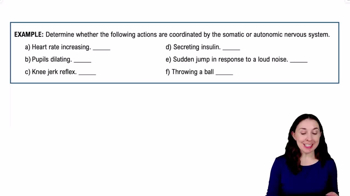
 1:10
1:10