What are the two major divisions of the human skeleton?
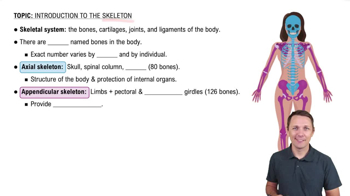
The skeleton is divided into the axial skeleton (80 bones) and the appendicular skeleton.
What bones make up the axial skeleton?
The axial skeleton includes the skull, vertebral column, thoracic cage (ribs and sternum), hyoid bone, and auditory ossicles.
What are the functions of the axial skeleton?
It supports and protects organs in body cavities, provides surface area for muscle attachment to adjust head, neck, trunk, perform respiratory movements, and stabilize appendicular skeleton parts.
How many bones are in the adult human skull and how are they categorized?
The skull has 22 bones: 8 cranial bones forming the braincase and 14 facial bones protecting entrances to digestive and respiratory tracts.
Name the 8 cranial bones of the skull.
The cranial bones are: frontal, parietal (2), temporal (2), occipital, sphenoid, and ethmoid.
What is the function of the cranial bones?
They form the braincase and protect the brain, brain fluids, blood vessels, nerves, and membranes.
Sutures are immovable joints connecting cranial bones with dense fibrous connective tissue. Major sutures include lambdoid, coronal, sagittal, and squamous.
What are fontanelles and their function?
Fontanelles are soft, non-ossified areas between cranial bones in infants that allow brain growth and ease passage through the birth canal.
What is the occipital bone and its key features?
The occipital bone forms the posterior and inferior cranium. Key landmarks include the foramen magnum, occipital condyles, and jugular foramen.
What is the function of the sphenoid bone?
The sphenoid forms part of the floor of the cranium, unites cranial and facial bones, strengthens skull sides, and contains the sphenoidal sinuses.
What is the ethmoid bone and its functions?
The ethmoid forms the anteromedial floor of the cranium, roof of nasal cavity, part of nasal septum, and medial orbital wall. It contains ethmoidal air cells (sinuses).
What are the paranasal sinuses and their functions?
Paranasal sinuses are air-filled chambers in frontal, sphenoid, maxillary, palatine bones, and ethmoidal air cells that lighten the skull, protect respiratory entrances, and serve as resonating chambers for speech.
What bones form the nasal cavity and paranasal sinuses?
Nasal cavity walls and sinuses include frontal, sphenoid, ethmoid, maxillae, palatine, lacrimal, inferior nasal conchae, and nasal bones.
What is the vertebral column composed of?
The vertebral column has 26 bones: 7 cervical, 12 thoracic, 5 lumbar vertebrae, plus the sacrum and coccyx.
What are the four spinal curves and their classification?
Primary curves (thoracic and sacral) develop before birth; secondary curves (cervical and lumbar) develop after birth to balance body weight.
What distinguishes cervical vertebrae from others?
Cervical vertebrae have small bodies, large vertebral foramina, transverse foramina for vertebral arteries, and bifid spinous processes (except C7).
What is unique about the atlas (C1) and axis (C2) vertebrae?
Atlas (C1) has no body or spinous process and articulates with occipital condyles; axis (C2) has the dens (odontoid process) that allows head rotation.
What are the true ribs and how do they differ from false ribs?
True ribs (1-7) attach directly to the sternum via their own costal cartilages; false ribs (8-12) attach indirectly or not at all (floating ribs 11-12).
What are the three parts of the sternum?
The sternum consists of the manubrium (articulates with clavicle and R1), body (attaches R2-R7 costal cartilages), and xiphoid process (attachment for diaphragm and abdominal muscles).
 Back
 4:50
