 Back
Axial Skeleton - Anatomy & Physiology
 4:50

Terms in this set (20)
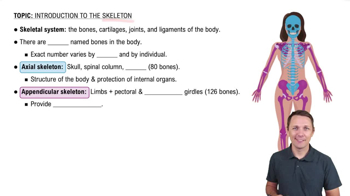
The part of the skeleton that includes the skull, vertebral column, ribs, and sternum.
Composed of cranial and facial bones; protects the brain and supports facial structures.
Eight bones that form the protective case around the brain.
Fourteen bones that form the structure of the face and provide cavities for the sense organs.
Series of vertebrae extending from the skull to the pelvis, protecting the spinal cord.
Cervical (7), Thoracic (12), Lumbar (5), Sacrum (5 fused), Coccyx (4 fused).
Cartilaginous pads between vertebrae that absorb shock and allow movement.
Flat bone in the center of the chest; consists of the manubrium, body, and xiphoid process.
12 pairs of curved bones that protect thoracic organs; classified as true, false, or floating ribs.
First 7 pairs of ribs directly attached to the sternum via costal cartilage.
Ribs 8-10; indirectly attached to the sternum via cartilage of the rib above.
Ribs 11-12; not attached to the sternum at all.
Large opening in the occipital bone where the spinal cord connects to the brain.
First cervical vertebra; supports the skull and allows nodding motion.
Second cervical vertebra; has the odontoid process (dens) allowing head rotation.
Thick, disc-shaped anterior portion of a vertebra that bears weight.
Posterior projection from a vertebra for muscle and ligament attachment.
Lateral projections from vertebrae for muscle attachment and rib articulation.
Five fused vertebrae forming the posterior wall of the pelvis.
Tailbone; composed of 3-5 fused vertebrae at the base of the vertebral column.