Back

Axial Skeleton - Anatomy & Physiology

Control buttons has been changed to "navigation" mode.
1/36
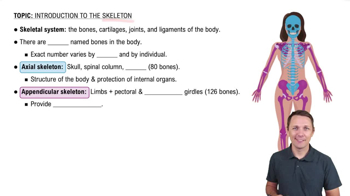
  • Axial skeleton

    skull, vertebral column, and thoracic cage.

  • Appendicular skeleton

    limbs and girdles (shoulder and pelvic).

  • Three major divisions of the axial skeleton

    Skull, vertebral column, and thoracic cage.
  • Functions of the axial skeleton

    Supports and protects the brain, spinal cord, and organs in the thorax; provides attachment sites for muscles.
  • Cranial bones

    Frontal, parietal, occipital, temporal, sphenoid, and ethmoid bones.
  • Major skull sutures

    Coronal, sagittal, lambdoid, and squamous sutures.
  • Fontanelles

    Soft spots on a baby's skull that allow for brain growth and skull flexibility during birth.
  • Auditory ossicles

    Three small bones in the middle ear: malleus, incus, and stapes; involved in hearing.
  • Occipital condyles

    Rounded projections on the occipital bone that articulate with the first cervical vertebra (atlas).
  • Foramen magnum

    Large opening in the occipital bone through which the spinal cord passes.
  • Sella turcica

    A saddle-shaped depression in the sphenoid bone that houses the pituitary gland.
  • Mastoiditis

    Infection of the mastoid process of the temporal bone; can lead to serious health complications if untreated.
  • Sutural bones

    Small, irregular bones found within sutures of the skull, formed by extra ossification centers.
  • Facial bones

    Mandible, maxillary, zygomatic, nasal, lacrimal, palatine, vomer, and inferior nasal conchae bones.
  • Alveolar process

    The part of the maxilla and mandible that contains the tooth sockets (dental alveoli).
  • Mandibular fossa

    Depression in the temporal bone that articulates with the mandible.
  • Lacrimal fossa

    A depression in the lacrimal bone that houses the lacrimal sac for tear drainage.
  • Hyoid bone

    A U-shaped bone in the neck that supports the tongue and is not directly attached to other bones.
  • Paranasal sinuses

    Air-filled cavities in the frontal, sphenoid, ethmoid, and maxillary bones that lighten the skull and enhance voice resonance.
  • Vertebral column divisions

    Cervical (7), thoracic (12), lumbar (5), sacrum (5 fused), and coccyx (4 fused) vertebrae.
  • Intervertebral discs

    Fibrocartilage pads between vertebrae that absorb shock and allow movement.
  • Herniated disc

    Condition where the nucleus pulposus protrudes through the annulus fibrosus, causing nerve compression and pain.
  • Normal curves of the vertebral column

    Cervical and lumbar lordosis (concave posteriorly), thoracic and sacral kyphosis (convex posteriorly).
  • Abnormal spinal curves

    Scoliosis (lateral curve), kyphosis (excessive thoracic curve), and lordosis (excessive lumbar curve).
  • Typical vertebra parts

    Body (centrum), vertebral arch, vertebral foramen, spinous and transverse processes, and articular processes.
  • Atlas (C1)

    First cervical vertebra; supports the skull and allows nodding motion; lacks a body.
  • Axis (C2) and dens

    Second cervical vertebra with the dens (odontoid process) that acts as a pivot for head rotation.
  • Transverse foramina

    Openings in cervical vertebrae that allow passage of the vertebral arteries.
  • Thoracic vertebrae

    T1-T12 vertebrae that articulate with ribs via facets.
  • Lumbar vertebrae

    L1-L5 vertebrae designed for weight bearing and muscle attachment.
  • Sacrum

    Five fused vertebrae forming a triangular bone that connects the spine to the pelvis.
  • Coccyx

    Tailbone composed of four fused vertebrae at the base of the vertebral column.
  • Spina bifida

    Congenital defect where the vertebral arch fails to close, potentially exposing the spinal cord.
  • Thoracic cage components

    Sternum, ribs, and thoracic vertebrae that protect thoracic organs and support respiration.
  • Sternum sections

    Manubrium, body, and xiphoid process.
  • Rib types

    Vertebrosternal (true ribs 1-7), vertebrochondral (false ribs 8-10), and vertebral (floating ribs 11-12).