 Back
Axial Skeleton - Anatomy & Physiology
 4:50

Terms in this set (20)
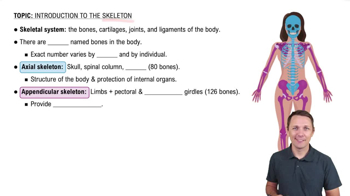
The axial skeleton consists of the bones along the central axis of the body, including the skull, vertebral column, and thoracic cage.
The skull includes the cranial bones and facial bones.
The vertebral column supports the head, protects the spinal cord, and provides attachment points for ribs and muscles.
There are typically 33 vertebrae divided into cervical, thoracic, lumbar, sacral, and coccygeal regions.
The thoracic cage is formed by the thoracic vertebrae, ribs, and sternum.
The thoracic cage protects vital organs like the heart and lungs and supports the shoulder girdle and upper limbs.
The sternum consists of the manubrium, body, and xiphoid process.
There are 12 pairs of ribs in the human body.
True ribs attach directly to the sternum; false ribs attach indirectly or not at all.
Floating ribs are the last two pairs of ribs that do not attach to the sternum at all.
Cranial bones protect the brain and provide attachment sites for head and neck muscles.
Facial bones form the structure of the face and provide cavities for sensory organs.
The cervical vertebrae are located in the neck region and consist of 7 vertebrae.
The atlas supports the skull; the axis allows head rotation.
Lumbar vertebrae are larger and support more weight; thoracic vertebrae have rib facets.
The sacrum and coccyx form the base of the axial skeleton.
The sacrum is a triangular bone formed by fused vertebrae that connects the spine to the pelvis.
The coccyx, or tailbone, is the small bone at the base of the vertebral column made of fused vertebrae.
The axial skeleton provides the central framework that supports the body and maintains posture.
The skull protects the brain, and the vertebral column protects the spinal cord.