What is the axial skeleton and its main functions?
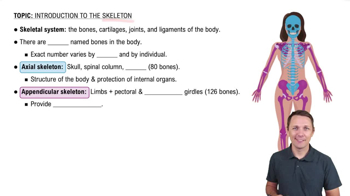
The axial skeleton forms the central axis of the body with about 80 bones. It provides support, protects vital organs, and offers muscle attachment sites.
Which bones make up the axial skeleton?
The axial skeleton includes the skull, vertebral column, thoracic cage, hyoid bone, and auditory ossicles.
How many bones compose the skull and how are they categorized?
The skull has 22 bones divided into 8 cranial bones and 14 facial bones.
Name the cranial bones and one key feature of each.
What is the function of the foramen magnum in the occipital bone?
It is a large opening allowing passage of the medulla oblongata and vertebral arteries between brain and spinal cord.
What are paranasal sinuses and their functions?
Air-filled chambers (frontal, sphenoidal, maxillary, ethmoidal) that lighten the skull and help produce mucus to clean, warm, and humidify inhaled air.
Which bones form the nasal septum?
The nasal septum is formed by the vomer, perpendicular plate of the ethmoid, and nasal cartilage.
What is unique about the hyoid bone?
The hyoid bone does not articulate with other bones; it supports the tongue and aids in swallowing and speech.
What are auditory ossicles and their role?
Tiny bones (malleus, incus, stapes) within the temporal bones that transmit sound vibrations for hearing.
How many vertebrae are in the vertebral column and what are its regions?
There are 26 bones: 24 vertebrae divided into cervical (7), thoracic (12), lumbar (5), plus the sacrum and coccyx.
What are the primary and secondary vertebral curves?
Primary curves (thoracic and sacral) are present at birth; secondary curves (cervical and lumbar) develop after birth for balance and shock absorption.
Describe the typical structure of a vertebra.
A vertebra has a vertebral body (weight-bearing), vertebral arch (surrounds spinal cord), vertebral foramen (spinal cord passage), spinous and transverse processes (muscle attachment), and articular processes (connect vertebrae).
What distinguishes cervical vertebrae from others?
Cervical vertebrae are the smallest, have large vertebral foramina, and contain transverse foramina for vertebral blood vessels.
What is the atlas (C1) and its function?
The atlas supports the skull, lacks a body and spinous process, and articulates with occipital condyles to allow nodding.
What is the axis (C2) and its unique feature?
The axis allows head rotation and has the dens (odontoid process) projecting upward for pivoting.
What are the characteristics of thoracic vertebrae?
Thoracic vertebrae have heart-shaped bodies, long spinous processes, and costal facets for rib articulation.
How do lumbar vertebrae differ from others?
Lumbar vertebrae are the largest with thick bodies to support more weight.
What bones form the thoracic cage and its functions?
The thoracic cage includes thoracic vertebrae, ribs, costal cartilages, and sternum; it protects heart and lungs and aids breathing.
Differentiate true, false, vertebrochondral, and floating ribs.
True ribs (1–7) attach directly to sternum; false ribs (8–12) do not; vertebrochondral ribs (8–10) attach indirectly via rib 7 cartilage; floating ribs (11–12) have no sternum attachment.
What is the role of costal cartilage?
Costal cartilage connects ribs to the sternum or other cartilages, providing flexibility for breathing.
Name the parts of the sternum and a key feature of each.
Manubrium (top, articulates with clavicles and first ribs), body (middle, largest, articulates with costal cartilages), xiphoid process (bottom, muscle attachment).
What is the sternal angle and its significance?
The sternal angle is the junction between manubrium and body, serving as an important anatomical landmark.
How does the rib cage move during breathing?
Ribs move upward and outward to increase thoracic volume, allowing air into the lungs; the rib cage also absorbs shock.
What are sutures in the skull?
Sutures are immovable joints between skull bones that provide stability and strength.
Name the major sutures of the skull.
Sagittal (between parietal bones), coronal (frontal and parietal), lambdoid (occipital and parietal), squamous (temporal and parietal).
What is the calvaria?
The calvaria, or skullcap, is formed by the frontal, parietal, and occipital bones.
What is the function of nasal conchae?
Nasal conchae create air turbulence to warm and humidify inhaled air.
 Back
 4:50
