 Back
BackAxial Skeleton Anatomy & Physiology Flashcards
 4:50
4:50
Terms in this set (46)
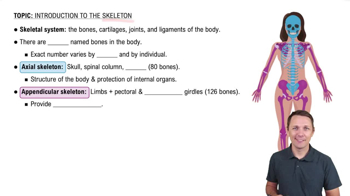
80 bones make up the axial skeleton.
Includes the skull, vertebral column, and thoracic cage.
Supports and protects organs, provides muscle attachment, enables movement of head, neck, trunk, and helps breathing.
The skull has 22 bones.
Cranial bones (8) protect the brain; facial bones (14) form the face structure.
Frontal, Parietal (2), Temporal (2), Occipital, Sphenoid, Ethmoid.
Forms the back of the skull.
Opening in occipital bone for the spinal cord to pass through.
Forms the forehead and eye sockets.
Protect the ear and assist in jaw movement.
Connects all skull bones together.
Forms part of the nasal cavity.
The maxilla is the largest facial bone.
The mandible forms the lower jaw.
The zygomatic bone forms the cheekbone.
The vomer and ethmoid bones form the nasal septum.
Air-filled spaces within the skull bones.
Lighten the skull, trap particles with mucus, and help with voice resonance.
Immovable joints between skull bones.
Sagittal, Coronal, Lambdoid, and Squamous sutures.
Between the two parietal bones.
Between the frontal and parietal bones.
Between the parietal and occipital bones.
Soft spots in a baby’s skull that allow brain growth.
The vertebral column has 26 bones.
Cervical (7), Thoracic (12), Lumbar (5), Sacrum, Coccyx.
Thoracic and Sacral curves are primary (present at birth).
Cervical and Lumbar curves develop after birth.
Atlas, which holds the skull.
Axis, which allows head rotation.
Acts as a pivot for head movement on the axis.
Supports weight of the body.
Passageway for the spinal cord.
Attachment site for muscles.
Made of fibrocartilage.
Provide shock absorption and flexibility to the spine.
Small size with large vertebral foramen.
Have facets for rib attachment.
Largest vertebrae, designed for weight bearing.
Five fused vertebrae forming the sacrum.
Three to five fused vertebrae forming the tailbone.
Ribs, sternum, and thoracic vertebrae.
Protects the heart and lungs.
Ribs 1–7, attach directly to the sternum.
Ribs 8–12, do not attach directly to the sternum.
Ribs 11–12, do not attach to the sternum at all.