 Back
BackAxial Skeleton Anatomy & Physiology Flashcards
 2:12
2:12
Terms in this set (20)
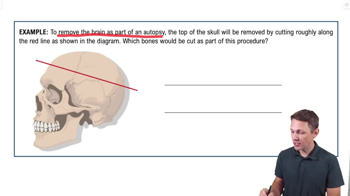
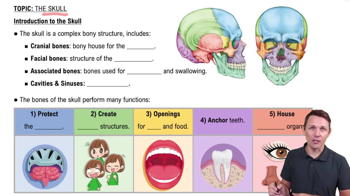
The anterior, middle, and posterior cranial fossae are the three depressions in the floor of the cranial base that house different parts of the brain.
The mandible contains the mental foramen, mental protuberance, mandibular angle, mandibular ramus, mandibular notch, coronoid process, mandibular condyle, and submandibular fossa.
The zygomatic bone has the temporal process that helps form the zygomatic arch.
The temporal bone includes the zygomatic process, zygomatic arch, mandibular fossa, external acoustic meatus, carotid canal, jugular foramen, styloid process, mastoid process, and foramen lacerum.
The occipital bone has the external occipital protuberance, superior and inferior nuchal lines, occipital condyles, hypoglossal canal, and the foramen magnum.
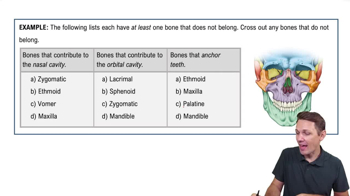
The sphenoid bone includes the greater wing, lesser wing, foramen spinosum, foramen ovale, sella turcica, optic canal, superior orbital fissure, and inferior orbital fissure.
The ethmoid bone contains the crista galli and the cribriform plate.
The frontal bone contains the supraorbital foramen and the glabella.
The maxilla contains the infraorbital foramen and the alveolar margin/process.
True ribs attach directly to the sternum, false ribs attach indirectly or not at all, and floating ribs have no anterior attachment.
A rib has a head, neck, tubercle, and a costal groove.
There are 7 cervical vertebrae. C1 is called the atlas and C2 is called the axis.
Typical vertebrae have a body, spinous process, transverse processes, superior and inferior articular facets, vertebral foramen, and lamina.
The foramen magnum allows passage of the spinal cord from the brainstem to the vertebral canal.
The sella turcica is a depression in the sphenoid bone that houses the pituitary gland.
The crista galli serves as an attachment point for the falx cerebri, a membrane that separates the brain hemispheres.
The temporal bone contains the external acoustic meatus, the ear canal opening.
The mandibular fossa is a depression in the temporal bone that articulates with the mandibular condyle.
The hypoglossal canal is in the occipital bone and transmits the hypoglossal nerve (cranial nerve XII) controlling tongue movement.
The zygomatic arch is formed by the zygomatic process of the temporal bone and the temporal process of the zygomatic bone.