What are the two main divisions of the human skeleton?
The skeleton is divided into the axial skeleton (80 bones) and the appendicular skeleton (126 bones).
What bones make up the axial skeleton?
The axial skeleton consists of the skull, vertebral column, and bony thorax (ribs and sternum).
What is the function of bone markings such as projections and depressions?
Projections provide attachment sites for muscles and ligaments or help form joints, while depressions and openings allow passage of nerves and blood vessels.
What are the two main groups of bones forming the skull?
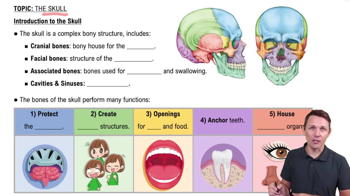
The skull is formed by cranial bones and facial bones.
What is the primary function of the cranium?
The cranium encloses the brain and provides attachment sites for some head and neck muscles.
List the functions of facial bones.
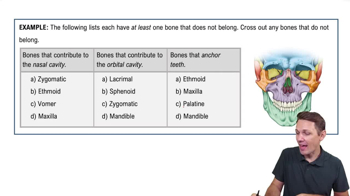
Facial bones form the framework of the face, cavities for sense organs, openings for air and food passage, hold teeth, and anchor facial muscles.
Name the paired and unpaired cranial bones.
Paired: Temporal and Parietal bones. Unpaired: Frontal, Occipital, Sphenoid, and Ethmoid bones.
What sutures are found in the cranium?
The four main sutures are coronal, sagittal, squamous, and lambdoid sutures.
What is the foramen magnum and where is it located?
The foramen magnum is a large opening in the occipital bone that allows passage of the spinal cord from the brain.
What are the key features of the temporal bone?
The temporal bone has squamous, tympanic, petrous, and mastoid regions and contains the external acoustic meatus and styloid process.
Describe the shape and location of the sphenoid bone.
The sphenoid bone spans the cranial floor, resembles a butterfly, and contains a body with three pairs of processes and five important openings.
What is the role of the ethmoid bone?
The ethmoid bone lies between the nasal and sphenoid bones and forms most of the medial bony region between the nasal cavity and orbits.
Name the unpaired and paired facial bones.
Unpaired: Mandible and Vomer. Paired: Maxillae, Zygomatic, Nasal, Lacrimal, Palatine, and Inferior nasal conchae.
What are the main parts of the mandible?
The mandible consists of a horizontal body and two upright rami.
What is the function of the maxillary bones?
Maxillary bones articulate with all facial bones except the mandible and contain the largest paranasal sinuses.
What are paranasal sinuses and their functions?
Paranasal sinuses are air-filled cavities in frontal, ethmoid, sphenoid, and maxillary bones that lighten the skull, moisten air, and help form vocal sounds.
What is unique about the hyoid bone?
The hyoid bone does not articulate with any other bone and acts as a movable base for the tongue and attachment for muscles.
How many bones form the vertebral column in adults?
The vertebral column is formed from 26 bones in adults.
What are intervertebral discs composed of and their function?
Intervertebral discs are made of fibrocartilage with a gelatinous nucleus pulposus and act as shock absorbers between vertebrae.
Name the five major regions of the vertebral column.
What are the primary and secondary curvatures of the vertebral column?
Primary curves: thoracic and sacral (convex posteriorly). Secondary curves: cervical and lumbar (concave posteriorly).
What movements are allowed between vertebrae?
Movements include flexion, extension, lateral flexion (bending), and rotation along the long axis.
What distinguishes cervical vertebrae from others?
Cervical vertebrae have large triangular vertebral foramina, bifid spinous processes (except C7), and transverse foramina.
What is the atlas and its function?
The atlas (C1) lacks a body and spinous process, supports the skull, and allows nodding the head 'yes'.
What is the axis and its unique feature?
The axis (C2) has a dens (odontoid process) that acts as a pivot for rotation of the atlas and skull, enabling head rotation 'no'.
What are the characteristics of thoracic vertebrae?
Thoracic vertebrae have heart-shaped bodies, long inferiorly pointing spinous processes, and facets for rib articulation.
Describe lumbar vertebrae features.
Lumbar vertebrae have thick, robust bodies, blunt spinous processes, and allow flexion and extension but prevent rotation.
What bones form the bony thorax?
The bony thorax consists of thoracic vertebrae, ribs, sternum, and costal cartilage.
What are the three parts of the sternum?
The sternum is formed by the manubrium, body, and xiphoid process.
Differentiate true, false, and floating ribs.
True ribs (1-7) attach directly to the sternum, false ribs (8-12) attach indirectly or not at all, and floating ribs (11-12) have no anterior attachment.
Name common disorders of the axial skeleton curvature.
 Back
Back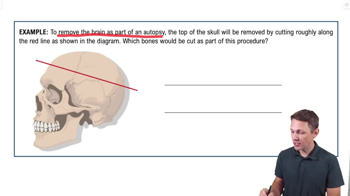
 2:12
2:12