 Back
BackAxial Skeleton and Vertebral Column - Anatomy & Physiology
 4:50
4:50
Terms in this set (20)
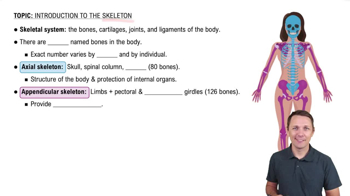
The axial skeleton includes bones of the body trunk such as the skull, vertebral column, and rib cage, but not shoulder bones, thigh bone, or foot bones.
The axial skeleton primarily protects nerves and blood vessels and supports the head and trunk; it does not allow movement of wrist, hand, ankle, or foot.
The axial skeleton consists of 80 bones, including the skull, vertebral column, and thoracic cage, not 126 bones.
The brain case includes bones like the frontal, parietal, occipital, temporal, sphenoid, and ethmoid, but not the zygomatic, maxillary, or lacrimal bones.
The lambdoid suture joins the parietal bones to the occipital bone, not to the frontal or temporal bones.
The middle cranial fossa is bounded anteriorly by the lesser wing of the sphenoid bone, not the petrous ridge.
Paranasal sinuses are air-filled spaces within certain skull bones connected to the nasal cavity, not found in all skull bones.
The sphenoid bone includes the greater and lesser wings, body, and pterygoid processes, but not the squamous portion or zygomatic process.
The carotid canal is located in the petrous part of the temporal bone, not in the anterior cranial fossa.
The cervical region consists of 7 vertebrae, not 12 or 5.
Primary curvatures include the thoracic and sacral curves present at birth; lumbar and cervical curves develop later.
A typical vertebra has a vertebral foramen, a single spinous process projecting posteriorly, and superior articular processes projecting upward.
A typical lumbar vertebra has a large, thick body, no transverse foramina, and no rib articulation sites.
The ligamentum flavum is found throughout the vertebral column, but the cervical region uniquely has transverse foramina in vertebrae.
The sternum consists of three parts: manubrium, body, and xiphoid process.
The sternal angle is the junction between the manubrium and the body of the sternum, not the body and xiphoid process.
The tubercle of a rib articulates with the transverse process of a thoracic vertebra.
True ribs are ribs 1–7 and attach directly to the sternum via their own costal cartilages.
Facial bones form by intramembranous ossification, while vertebrae develop from hyaline cartilage models formed by the notochord.
A fontanelle is a soft spot on an infant's skull where cranial bones have not yet fused.