 Back
Axial Skeleton Bones - Anatomy & Physiology
 4:50

Terms in this set (20)
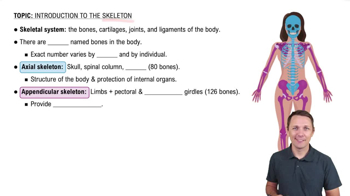
The axial skeleton includes the skull, vertebral column, rib cage, and hyoid bone.
The skull has 22 bones, divided into the cranial bones and facial bones.
Frontal, 2 Parietal, 2 Temporal, Occipital, Sphenoid, and Ethmoid bones.
2 Nasal, 2 Maxillae, 2 Zygomatic, Mandible, 2 Lacrimal, 2 Palatine, 2 Inferior nasal conchae, and Vomer.
It supports the head and trunk, protects the spinal cord, and provides attachment points for ribs and muscles.
There are 33 vertebrae: 7 cervical, 12 thoracic, 5 lumbar, 5 fused sacral, and 4 fused coccygeal.
They are the smallest vertebrae and include the atlas and axis which support and rotate the head.
The rib cage consists of 12 pairs of ribs and the sternum.
Manubrium, body (gladiolus), and xiphoid process.
Ribs are classified as true ribs (1-7), false ribs (8-12), and floating ribs (11-12).
True ribs attach directly to the sternum via their own costal cartilage.
False ribs attach indirectly to the sternum or not at all.
The hyoid bone is a U-shaped bone in the neck that supports the tongue and is an attachment point for muscles.
The hyoid bone does not articulate with any other bone.
Cranial bones protect the brain and provide attachment sites for head and neck muscles.
Facial bones form the structure of the face, protect sensory organs, and provide attachment for muscles of expression and mastication.
The 5 sacral vertebrae are fused to form the sacrum.
The 4 coccygeal vertebrae are fused to form the coccyx (tailbone).
The atlas supports the skull and allows nodding; the axis has the dens for head rotation.
There are 2 pairs of floating ribs (ribs 11 and 12) that do not attach to the sternum.