 Back
BackAxial Skeleton in Anatomy & Physiology
You can tap to flip the card.
Control buttons has been changed to "navigation" mode.
1/10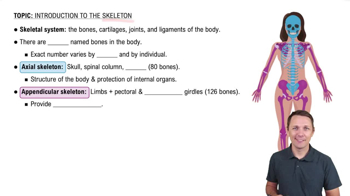
 4:50
4:50
Terms in this set (10)
Skull, Vertebral Column (Spine), and Rib Cage (Ribs & Sternum).
Protects the brain and forms the structure of the face.
Supports body weight, protects the spinal cord, and allows flexible movement.
Protects the heart and lungs and assists in breathing.
About 80 bones out of the 206 in the adult body.
Along the body’s midline, forming the core structure.
Support, Protection, and Attachment for muscles.
By providing the main framework that supports the body’s posture and structure.
The brain, spinal cord, heart, and lungs.
It serves as an anchor for muscles, allowing movement and stability.