Skip to main content
Anatomy & Physiology
My Course
Learn
Exam Prep
AI Tutor
Study Guides
Textbook Solutions
Flashcards
Explore
Try the app
My Course
Learn
Exam Prep
AI Tutor
Study Guides
Textbook Solutions
Flashcards
Explore
Try the app
Back
Body Cavities in Anatomy & Physiology
You can tap to flip the card.
What is the right pleural cavity?
You can tap to flip the card.
👆
What is the right pleural cavity?
The
right pleural cavity
is the space surrounding the right lung within the thoracic cavity.
Track progress
Control buttons has been changed to "navigation" mode.
1/9
Recommended videos
3:20
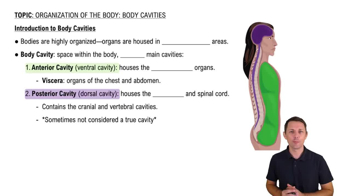
Introduction to Body Cavities
13202
views
291
rank
1:40
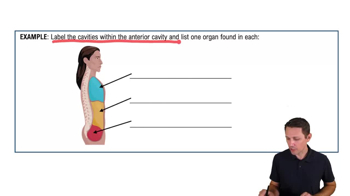
Organization of the Body: Body Cavities Example 2
7421
views
145
rank
3:25
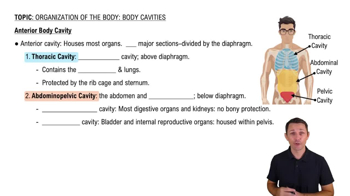
Anterior Body Cavity
8713
views
190
rank
Terms in this set (9)
Hide definitions
What is the right pleural cavity?
The
right pleural cavity
is the space surrounding the right lung within the thoracic cavity.
What is the left pleural cavity?
The
left pleural cavity
is the space surrounding the left lung within the thoracic cavity.
What is the thoracic cavity?
The
thoracic cavity
is the chest cavity that contains the lungs and heart, separated from the abdominal cavity by the diaphragm.
What is the mediastinum?
The
mediastinum
is the central compartment of the thoracic cavity containing the heart, trachea, esophagus, and major vessels.
What is the diaphragm?
The
diaphragm
is a muscular partition that separates the thoracic cavity from the abdominopelvic cavity.
What is the pericardial cavity?
The
pericardial cavity
is the space within the mediastinum that surrounds the heart.
What is the abdominal cavity?
The
abdominal cavity
is the upper part of the abdominopelvic cavity containing digestive organs like the stomach, liver, and intestines.
What is the abdominopelvic cavity?
The
abdominopelvic cavity
is the combined abdominal and pelvic cavities, housing digestive, urinary, and reproductive organs.
What is the pelvic cavity?
The
pelvic cavity
is the lower part of the abdominopelvic cavity containing the bladder, reproductive organs, and rectum.
 BackBack
 3:20