Back

Bones and Sutures of the Skull - Anatomy & Physiology

Control buttons has been changed to "navigation" mode.
1/17
  • What is the unique architecture of cranial bones and its function?

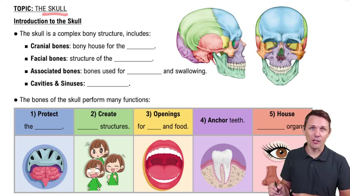
    Cranial bones have a diploe structure: a thin layer of spongy bone between two layers of compact bone, which minimizes skull weight while maintaining strength.
  • What are the key features of the occipital bone?

    Contains the external occipital protuberance (muscle attachment), foramen magnum (spinal cord passage), and occipital condyles (articulate with atlas/C1 vertebra).
  • What do the parietal bones form?

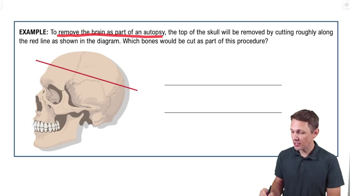
    They form most of the cranial vault, the upper sides and roof of the skull.
  • Name three important features of the frontal bone.

    Glabella (ridge between eyes), supraorbital foramen (nerve and vessel passage), and frontal sinus.
  • What are the notable features of the temporal bones?

    Include mastoid process (sternocleidomastoid attachment), styloid process (muscle attachment), and external auditory meatus (ear canal).
  • What structures are found in the ethmoid bone?

    Ethmoid sinus, cribriform plate (olfactory nerve passage), perpendicular plate (nasal septum), and crista galli (brain membrane attachment).
  • Why is the sphenoid bone called the 'bat bone' and what does it contain?

    Its shape resembles a bat; contains sphenoid sinus and sella turcica, which houses the pituitary gland.
  • What bones form the bridge and lower part of the nasal septum?

    Nasal bones form the bridge; vomer forms the lower part of the nasal septum.
  • Where are the lacrimal bones located and what is their function?

    Near the nasolacrimal canal, which carries tears from the eye to the nasal cavity.
  • What is the role of the zygomatic bones?

    Form the cheekbones and part of the orbital floor; transmit force from the cheek to the orbit.
  • What do the palatine bones form?

    The posterior third of the hard palate and a small part of the orbit.
  • What is the significance of the maxillae in skull anatomy?

    Form the anterior two-thirds of the hard palate; failure to fuse can cause cleft lip and palate.
  • Which is the only movable bone of the skull?

    The mandible.
  • What are the inferior nasal conchae?

    Curved bones located inside the nasal cavity.
  • What is the coronal suture?

    The suture that connects the frontal bone to the parietal bones.
  • What is the sagittal suture?

    The suture that connects the two parietal bones along the midline of the skull.
  • What is the lambdoidal suture?

    The suture that connects the occipital bone to the parietal bones.