Skip to main content
Anatomy & Physiology
My Course
Learn
Exam Prep
AI Tutor
Study Guides
Textbook Solutions
Flashcards
Explore
Try the app
My Course
Learn
Exam Prep
AI Tutor
Study Guides
Textbook Solutions
Flashcards
Explore
Try the app
Back
Bones of the Appendicular Skeleton
You can tap to flip the card.
What bones make up the pectoral (shoulder) girdle?
You can tap to flip the card.
👆
What bones make up the pectoral (shoulder) girdle?
The clavicle (collarbone) and scapula (shoulder blade).
Track progress
Control buttons has been changed to "navigation" mode.
1/17
Recommended videos
5:30
Overview of the Arm and Forearm
8959
views
179
rank
1
comments
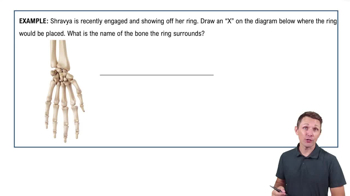
1:28
Bones of the Upper Limb Example 1
6269
views
104
rank
1
comments
5:04
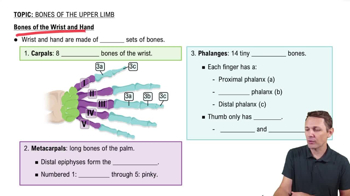
Overview of the Wrist and Hand
7827
views
162
rank
Terms in this set (17)
Hide definitions
What bones make up the pectoral (shoulder) girdle?
The clavicle (collarbone) and scapula (shoulder blade).
Function of the clavicle in the appendicular skeleton
Connects the arm to the trunk and helps stabilize shoulder movements.
Role of the scapula
Provides attachment for arm and chest muscles and allows a wide range of shoulder motion.
What is the humerus?
The upper arm bone that supports arm movement.
Functions of the radius and ulna
Forearm bones that allow rotation and movement of the wrist and hand.
How many carpal bones are there and their function?
There are 8 carpal bones; they allow wrist flexibility.
What are metacarpals and their role?
Five palm bones that support the hand.
Number and function of phalanges in the hand
14 finger bones that enable fine movements and grasping.
Components of the pelvic girdle
Hip bones: ilium, ischium, and pubis.
Functions of the pelvic girdle
Attaches legs to axial skeleton, supports body weight, and protects pelvic organs.
What is the femur?
The thigh bone; longest and strongest bone supporting body weight during standing and movement.
Role of the patella
Protects the knee joint and improves leverage for thigh muscles.
Difference between tibia and fibula
Tibia bears most weight; fibula stabilizes the ankle.
Number and function of tarsal bones
Seven ankle bones that support body weight and allow foot movement.
What are metatarsals?
Five foot bones that form the arch of the foot.
Number and function of phalanges in the foot
14 toe bones that help with balance and walking.
Main functions of the appendicular skeleton
Enable movement and locomotion, support and stabilize the body, protect organs, and provide muscle attachment points.
 BackBack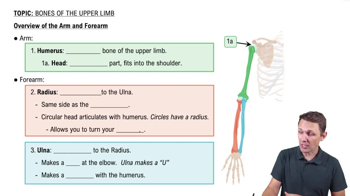
 5:30
5:30