 Back
Bones of the Skull and Their Features
 2:12

Terms in this set (20)
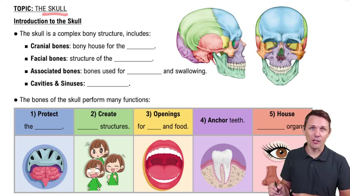
The skull bones are divided into the cranial bones and the facial bones.
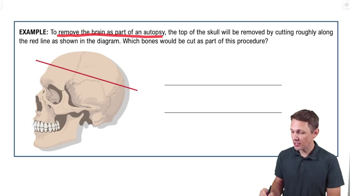
Frontal, parietal (2), temporal (2), occipital, sphenoid, and ethmoid bones.
They protect the brain and support the structures of the face.
The frontal bone forms the forehead and the upper part of the eye sockets.
They house the structures of the ears and form part of the cheekbones.
The occipital bone forms the back and base of the skull and contains the foramen magnum.
A large opening in the occipital bone allowing passage of the spinal cord.
Located at the base of the skull, it helps form the eye sockets and houses the pituitary gland.
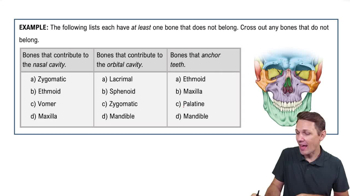
It forms part of the nasal cavity and the medial walls of the orbits.
Maxillae (2), palatine (2), nasal (2), inferior nasal conchae (2), zygomatic (2), lacrimal (2), vomer, and mandible.
It forms the upper jaw, holds the upper teeth, and forms part of the nose and eye sockets.
The mandible forms the lower jaw and holds the lower teeth.
They are the cheekbones and contribute to the eye sockets.
They form the bridge of the nose.
Small bones forming part of the medial wall of each orbit, containing the lacrimal sac for tear drainage.
It forms the inferior part of the nasal septum.
Thin, curved bones inside the nasal cavity that help filter and humidify air.
It forms part of the hard palate and the floor of the nasal cavity.
Sutures are immovable joints that connect the skull bones.
The squamous suture connects the parietal and temporal bones.