Skip to main content
Anatomy & Physiology
My Course
Learn
Exam Prep
AI Tutor
Study Guides
Textbook Solutions
Flashcards
Explore
Try the app
My Course
Learn
Exam Prep
AI Tutor
Study Guides
Textbook Solutions
Flashcards
Explore
Try the app
Back
Bones of the Skull: Structure and Function
You can tap to flip the card.
How many bones make up the skull (excluding ear bones and hyoid)?
You can tap to flip the card.
👆
How many bones make up the skull (excluding ear bones and hyoid)?
The skull is made up of
22 bones
, excluding the tiny ear bones and the hyoid.
Track progress
Control buttons has been changed to "navigation" mode.
1/20
Recommended videos
Guided course
2:12
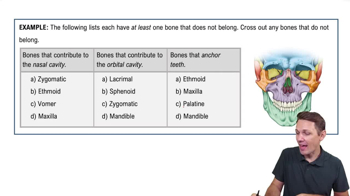
The Skull Example 1
9873
views
225
rank
Guided course
4:42
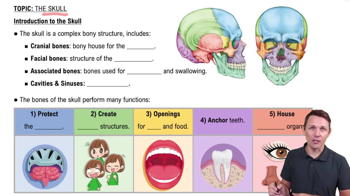
Introduction to the Skull
18052
views
412
rank
Guided course
3:40
The Skull Example 3
7167
views
138
rank
Terms in this set (20)
Hide definitions
How many bones make up the skull (excluding ear bones and hyoid)?
The skull is made up of
22 bones
, excluding the tiny ear bones and the hyoid.
What are the two main groups of skull bones?
Cranial bones (8)
and
Facial bones (14)
.
What is the primary function of the cranial bones?
They form the protective case around the brain.
What is the primary function of the facial bones?
They shape the face and support sensory structures.
What is the frontal bone and its function?
The
frontal bone
forms the forehead and upper eye sockets; it protects the brain and supports facial structures.
Where are the parietal bones located and what is their function?
The
parietal bones
form the sides and roof of the skull; they protect the brain and form the sides of the cranium.
What do the temporal bones do?
Located on the lower sides of the skull around the ears, they house structures for hearing and balance and protect the brain.
What is the occipital bone and its key feature?
The
occipital bone
forms the back and base of the skull; it protects the back of the brain and contains the foramen magnum for the spinal cord.
Describe the sphenoid bone and its functions.
A bat-shaped bone at the skull base; it supports the brain, forms part of the eye socket, and houses the pituitary gland.
What is the ethmoid bone's location and function?
Located between the eyes, it forms part of the nasal cavity and eye sockets, supports the nasal cavity, and allows passage of olfactory nerves.
What are the maxillae and their functions?
The
maxillae
are the upper jaw bones; they hold upper teeth and form parts of the nose and eye socket.
What do the palatine bones form?
They form the back part of the hard palate (roof of the mouth).
What are the zygomatic bones and their role?
The
zygomatic bones
are the cheekbones; they form part of the eye socket.
What is the function of the lacrimal bones?
Small bones forming part of the inner eye socket, associated with tear ducts.
Where are the nasal bones and what do they form?
They form the bridge of the nose.
What is the role of the inferior nasal conchae?
Located inside the nasal cavity, they increase surface area for air flow.
What is the vomer bone's function?
It forms part of the nasal septum, dividing the nasal cavity.
What is unique about the mandible?
The
mandible
is the lower jaw and the only movable bone of the skull; it holds the lower teeth.
List the main functions of the skull.
Protects the brain, shapes the face, supports facial muscles, anchors teeth, houses sensory organs, and provides openings for air and food.
Which bones anchor the teeth in the skull?
The
maxilla
anchors the upper teeth and the
mandible
anchors the lower teeth.
 BackBack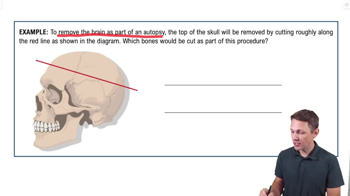
 2:12
2:12