Skip to main content
Anatomy & Physiology
My Course
Learn
Exam Prep
AI Tutor
Study Guides
Textbook Solutions
Flashcards
Explore
Try the app
My Course
Learn
Exam Prep
AI Tutor
Study Guides
Textbook Solutions
Flashcards
Explore
Try the app
Back
brennah Anatomy & Physiology: Cardiovascular and Respiratory System Key Concepts
You can tap to flip the card.
Primary locations of gas exchange in the respiratory system
You can tap to flip the card.
👆
Primary locations of gas exchange in the respiratory system
Gas exchange occurs primarily in the
alveoli
of the lungs where oxygen moves into the blood and carbon dioxide moves out.
Track progress
Control buttons has been changed to "navigation" mode.
1/29
Recommended videos
Guided course
4:28
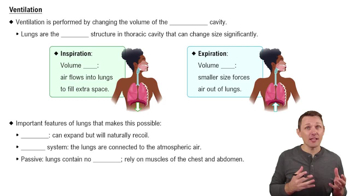
Ventilation
8372
views
195
rank
1
comments
Guided course
5:55
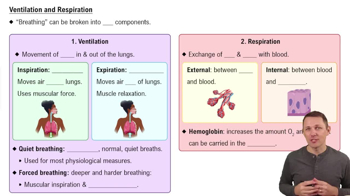
Ventilation and Respiration
12330
views
366
rank
1
comments
Guided course
1:37
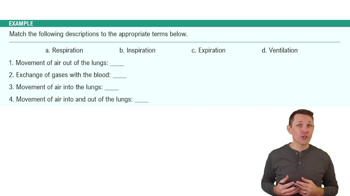
Introduction to Lung Physiology Example 1
8378
views
223
rank
1
comments
Terms in this set (29)
Hide definitions
Primary locations of gas exchange in the respiratory system
Gas exchange occurs primarily in the
alveoli
of the lungs where oxygen moves into the blood and carbon dioxide moves out.
Functions of the conducting zones in the respiratory system
The conducting zones
filter, warm, and humidify
air but do not participate in gas exchange.
Functions of the uvula and epiglottis
The
uvula
prevents food from entering the nasal cavity during swallowing; the
epiglottis
prevents food from entering the trachea.
Why do objects lodge more often in the right lung than the left?
The right main bronchus is more vertical and wider, so objects tend to lodge there more often than in the left due to
angle of connection
.
Difference between Type 1 and Type 2 alveolar cells
Type 1 cells
form the alveolar wall for gas exchange;
Type 2 cells
secrete surfactant to reduce surface tension.
Role of surfactant in the lungs
Surfactant reduces surface tension in alveoli, preventing collapse and aiding lung expansion.
Boyle's Law in respiration
At constant temperature,
pressure and volume are inversely related
; increasing lung volume decreases pressure, causing air to flow in.
Dalton's Law of partial pressures
Total pressure of a gas mixture equals the sum of the partial pressures of each gas.
What happens during normal inspiration?
The
diaphragm flattens
and
rib cage elevates
, increasing thoracic volume and decreasing pressure to draw air in.
What is a pleural effusion?
Accumulation of excess fluid in the pleural cavity, which can impair lung expansion.
What is pneumothorax?
Air in the pleural cavity causing lung collapse due to loss of negative pressure.
What is hemothorax?
Blood accumulation in the pleural cavity, often from trauma.
Triggers and effects of bronchiole constriction
Triggers include allergens and irritants; constriction
decreases airway diameter
and
increases resistance
to airflow.
Pathway of oxygen during gas exchange
Oxygen moves from
alveoli
into
blood
and then into
tissues
.
How many oxygen molecules can bind to one hemoglobin molecule?
One hemoglobin molecule can bind up to
4 oxygen molecules
.
Conditions that favor unloading of oxygen from hemoglobin to tissues
Increased
temperature
,
CO2 pressure
, and decreased pH favor oxygen unloading.
How is most carbon dioxide transported in the blood?
About 70% of CO2 is carried as
bicarbonate ions
in the plasma.
Primary function of alveolar macrophages
They perform
phagocytosis
to remove debris and pathogens in the alveoli.
Brain area controlling basic rhythm of breathing
The
medulla oblongata
controls the basic rhythm of breathing.
Function of the cardiovascular system
To
transport oxygen, nutrients, and waste
products throughout the body.
Number and function of heart chambers
The heart has 4 chambers: 2
atria
(receivers) and 2
ventricles
(pumps).
Difference between pulmonary arteries and veins
Pulmonary arteries carry
deoxygenated blood
to lungs; pulmonary veins carry
oxygenated blood
to the heart.
Purpose of auricles on the heart
Auricles increase atrial volume; the
left auricle
generates more pressure due to systemic circulation demands.
Function of heart valves
Valves prevent
backflow
and ensure unidirectional blood flow through the heart.
Role of the SA node
The SA node is the heart's
natural pacemaker
, initiating electrical impulses without conscious control.
Pathway of electrical conduction in the heart
Impulse travels from SA node → AV node → bundle of His → Purkinje fibers causing contraction.
Definition of cardiac output
Cardiac output is the volume of blood pumped by the heart per minute.
Heart sounds S1 and S2 represent which valve actions?
S1 is the
closure of AV valves
; S2 is the
closure of semilunar valves
.
Function of pericardial fluid
Pericardial fluid reduces
friction
between heart and pericardium during heartbeats.
 BackBack
 4:28