Skip to main content
Anatomy & Physiology
My Course
Learn
Exam Prep
AI Tutor
Study Guides
Textbook Solutions
Flashcards
Explore
Try the app
My Course
Learn
Exam Prep
AI Tutor
Study Guides
Textbook Solutions
Flashcards
Explore
Try the app
Back
Cell Cycle, Mitosis, and Protein Synthesis in Anatomy & Physiology
You can tap to flip the card.
What are the two major periods of the cell cycle?
You can tap to flip the card.
👆
What are the two major periods of the cell cycle?
Interphase
(cell growth and usual activities) and
Mitotic phase
(cell division).
Track progress
Control buttons has been changed to "navigation" mode.
1/20
Recommended videos
Guided course
04:44
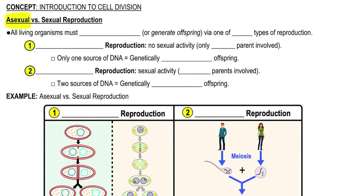
Asexual vs. Sexual Reproduction
18018
views
384
rank
Guided course
09:40
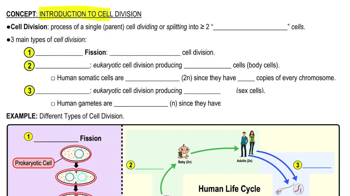
Introduction to Cell Division
27430
views
622
rank
1
comments
Guided course
03:18
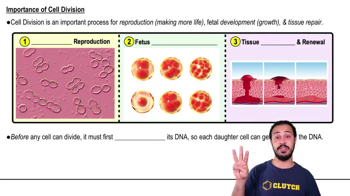
Importance of Cell Division
17217
views
554
rank
Terms in this set (20)
Hide definitions
What are the two major periods of the cell cycle?
Interphase
(cell growth and usual activities) and
Mitotic phase
(cell division).
What are the subphases of Interphase?
G1
(growth and metabolism),
S
(DNA replication), and
G2
(preparation for division).
What are the two distinct events of the Mitotic phase?
Mitosis
(division of the nucleus) and
Cytokinesis
(division of the cytoplasm).
What happens during early prophase of mitosis?
Chromatin condenses into visible chromosomes; sister chromatids held by centromere; centrosomes synthesize microtubules forming the mitotic spindle.
What occurs during late prophase?
Nuclear envelope breaks down; kinetochore microtubules attach to centromeres; nonkinetochore microtubules push poles apart.
Describe the metaphase stage of mitosis.
Chromosome centromeres align precisely at the cell's equator on the metaphase plate.
What key events happen in anaphase?
Centromeres split; sister chromatids pulled to opposite poles by kinetochore motor proteins; nonkinetochore microtubules push poles apart.
What occurs during telophase?
Chromosomes uncoil into chromatin; new nuclear membranes form; nucleoli reappear; spindle disappears.
What is cytokinesis and when does it occur?
Division of cytoplasm by actin microfilament ring forming cleavage furrow; begins in late anaphase and continues through mitosis.
What is the role of DNA in protein synthesis?
DNA holds the master blueprint for proteins, directing amino acid order in polypeptides via genes.
What is a gene?
A DNA segment coding for one polypeptide, composed of coding exons and noncoding introns.
What are the three types of RNA involved in protein synthesis?
Messenger RNA (mRNA)
,
Ribosomal RNA (rRNA)
, and
Transfer RNA (tRNA)
.
What is the function of mRNA?
Copies DNA code in nucleus (transcription) and carries it to ribosomes in cytoplasm.
What is transcription?
Process where RNA polymerase synthesizes mRNA from DNA template in three phases: initiation, elongation, termination.
How is pre-mRNA processed before translation?
Introns are removed by spliceosomes, leaving only exons in mature mRNA.
What is the role of rRNA?
Structural component of ribosomes, facilitating translation of mRNA into polypeptides.
What is the function of tRNA?
Carries specific amino acids and uses anticodons to match mRNA codons during translation.
What is the genetic code?
Triplet base sequences (codons) on mRNA that specify amino acids; 64 codons code for 20 amino acids with redundancy.
What are the three phases of translation?
Initiation (ribosome assembly at start codon), elongation (amino acid chain formation), termination (stop codon recognition and release).
How does the rough ER participate in protein synthesis?
Ribosomes dock on rough ER via signal sequences; proteins enter ER for folding, modification, and packaging into vesicles for Golgi.
 BackBack
 04:44