 Back
BackCell Transport & Permeability - Anatomy & Physiology
 02:44
02:44
Terms in this set (28)
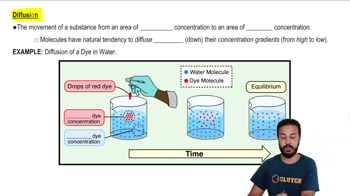
Diffusion is the net, spontaneous movement of particles from an area of higher concentration to an area of lower concentration.
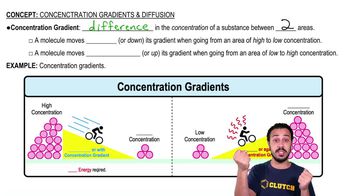
The concentration gradient is the difference in the density or amount of a specific substance between two distinct areas.
Equilibrium is a stable state where particles become evenly distributed, resulting in no further net movement.
Kinetic energy is the inherent energy of motion in particles that drives random collisions fueling diffusion.
Simple diffusion is the unassisted passive movement of small, nonpolar solutes directly through the plasma membrane's lipid bilayer.
Facilitated diffusion is passive transport of polar or charged molecules across a membrane with the help of specialized membrane proteins.
Osmosis is the net diffusion of water across a selectively permeable membrane toward a higher solute concentration.
A hypotonic solution has a lower concentration of non-penetrating solutes than inside the cell, causing water to enter the cell.
A hypertonic solution has a higher concentration of non-penetrating solutes than inside the cell, causing water to leave the cell.
An isotonic solution has an equal concentration of non-penetrating solutes compared to the cell interior, resulting in no net water movement.
Tonicity is the ability of an extracellular solution to change cell volume by driving water movement via osmosis.
Crenation is the shrinking or shriveling of a cell due to water loss in a hypertonic environment.
Lysis is the bursting of a cell membrane caused by excessive water influx in a hypotonic environment.
An active process requires cellular energy (ATP) to move substances against their concentration gradient or move large molecules.
A passive process moves substances down a concentration gradient without using cellular energy (ATP).
Carrier-mediated transport uses specialized membrane proteins to bind and move substances through the lipid bilayer, either passively or actively.
Solute is the substance dissolved in a solution; solvent is the dissolving medium, usually water in biological systems.
Vesicular transport is an active process using membrane-bound vesicles to move bulk fluids or large particles across the cell membrane.
Endocytosis is vesicular transport where the plasma membrane folds inward to engulf external materials into the cell.
Exocytosis is vesicular transport where internal vesicles fuse with the plasma membrane to expel materials out of the cell.
Active processes require ATP energy; passive processes occur spontaneously without energy use.
Simple diffusion passes molecules directly through the lipid bilayer; facilitated diffusion requires membrane proteins.
A membrane-bound carrier is a transmembrane protein that binds specific solutes to transport them across the membrane.
Filtration is passive transport forcing water and small solutes through a membrane or capillary wall by pressure.
The driving force behind diffusion is the inherent kinetic energy of atoms or molecules.
A higher solute concentration increases gradient steepness, speeding up diffusion; a lower concentration slows it down.
Pinocytosis is cell drinking; phagocytosis is cell eating; receptor-mediated endocytosis is selective uptake via ligand-receptor binding.
Diffusion rate is affected by temperature, molecule size, surface area, membrane permeability, and gradient steepness.