What is passive transport across the cell membrane?
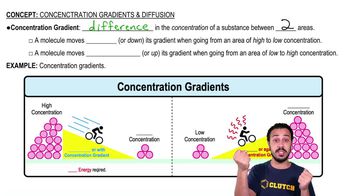
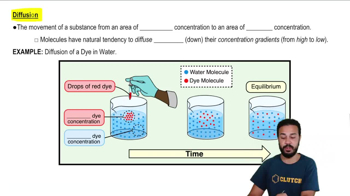
Movement of molecules from high to low concentration without energy input, including simple diffusion, facilitated diffusion, and osmosis.
Define simple diffusion.
Movement of nonpolar lipid-soluble substances directly through the phospholipid bilayer down their concentration gradient without energy.
What types of molecules typically move by simple diffusion?
Oxygen, carbon dioxide, steroid hormones, fatty acids, and small amounts of water.
Describe carrier-mediated facilitated diffusion.
Transport of specific polar molecules like sugars and amino acids by transmembrane proteins that change shape to move molecules down their concentration gradient without energy.
What is channel-mediated facilitated diffusion?
Movement of ions or molecules through water-filled protein channels down their concentration gradient without energy.
What are the two types of channels in channel-mediated facilitated diffusion?
Leakage channels (always open) and gated channels (controlled by chemical or electrical signals).
Explain osmosis in cell transport.
Movement of water through a selectively permeable membrane from low solute (high water) concentration to high solute (low water) concentration.
How does water cross the plasma membrane during osmosis?
Through the lipid bilayer and specific water channels called aquaporins.
What is osmolarity?
The total concentration of all solute particles in a solution, expressed in osmoles per liter (osmol/L).
Define tonicity and its types.
Ability of a solution to change cell water volume: isotonic (no change), hypertonic (cell shrinks), hypotonic (cell swells).
What is active transport?
Energy-requiring process that moves solutes against their concentration gradient using ATP.
Describe primary active transport.
Direct use of ATP hydrolysis by transport proteins (pumps) to move ions like Na+ and K+ across the membrane.
What is the sodium-potassium pump?
A primary active transport pump that moves 3 Na+ out and 2 K+ into the cell using ATP.
Explain secondary active transport.
Uses energy stored in ion gradients created by primary active transport to move multiple substances via cotransport proteins.
Differentiate symporters and antiporters in secondary active transport.
Symporters move two substances in the same direction; antiporters move one substance in while moving another out.
What is vesicular transport?
Active transport moving large substances or amounts across membranes inside vesicles, requiring ATP.
Name the two main types of vesicular transport.
Endocytosis (into cell) and exocytosis (out of cell).
Describe phagocytosis.
Endocytosis where the cell engulfs large particles by forming pseudopods, creating a phagosome that fuses with lysosomes.
What is pinocytosis?
Non-specific endocytosis where the cell ingests extracellular fluid and dissolved solutes in tiny vesicles.
Explain receptor-mediated endocytosis.
Selective endocytosis where substances bind to specific receptors, triggering vesicle formation to ingest and concentrate substances.
What occurs during exocytosis?
Vesicles fuse with the plasma membrane to eject substances like hormones, neurotransmitters, mucus, or wastes from the cell.
 Back
 02:44