Obtain nutrients, make molecules needed to survive, dispose of wastes, maintain shape and integrity, and replicate itself.
Describe the structure of the plasma membrane.
A fluid mosaic model with a phospholipid bilayer and embedded proteins, including integral and peripheral proteins.
What is the function of integral proteins in the plasma membrane?
They are firmly embedded in the lipid bilayer and can act as receptors or channels for selective substance transport.
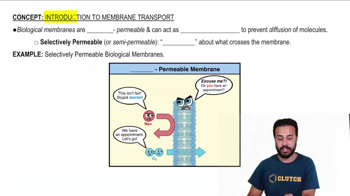
What does the term 'selectively permeable' mean regarding the plasma membrane?
The membrane allows some substances to enter or leave the cell while blocking others.
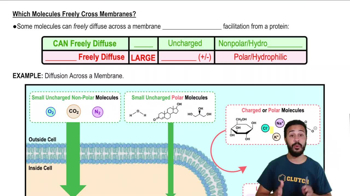
What is simple diffusion?
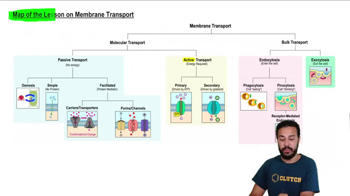
Movement of molecules down their concentration gradient directly through the phospholipid bilayer.
What is osmosis?
Diffusion of water molecules across a membrane through specific channels or the lipid bilayer.
Define facilitated diffusion.
Movement of molecules down their concentration gradient through an integral protein channel.
What is active transport?
Movement of molecules against their concentration gradient using energy (ATP) via transport proteins.
What are the two main types of endocytosis?
Phagocytosis (cell eating) and pinocytosis (cell drinking).
Describe receptor-mediated endocytosis.
Specific molecules bind to receptor proteins in coated pits, which invaginate and form vesicles to bring substances into the cell.
What is exocytosis?
A process where substances enclosed in vesicles are released out of the cell by vesicle fusion with the plasma membrane.
What are ribosomes and their function?
Made of proteins and rRNA, ribosomes are the site of protein synthesis (translation).
Differentiate between free and bound ribosomes.
Free ribosomes function in the cytosol; bound ribosomes are attached to rough ER and make proteins for export or membrane renewal.
What are the functions of rough and smooth endoplasmic reticulum?
Rough ER synthesizes secreted proteins; smooth ER performs lipid metabolism, drug detoxification, and stores Ca2+.
What is the role of the Golgi apparatus?
Sorts and packages proteins from rough ER and sends them to their proper destinations.
What are lysosomes and their function?
Membrane sacs containing digestive enzymes that break down unwanted substances; act as the cell's demolition crew.
What is the function of mitochondria?
Generate most of the cell's energy by producing ATP through chemical bond energy release.
What are peroxisomes and their role?
Membrane sacs with enzymes that neutralize free radicals, break down poisons, and fatty acids.
Describe the cytoskeleton and its components.
Network of rods including microfilaments (actin), intermediate filaments (tough fibers), and microtubules (tubulin) that support cell shape and movement.
What is the nucleus and its main parts?
Control center housing DNA; main parts are nuclear envelope (double membrane with pores), nucleolus (ribosome assembly), and chromatin (DNA-protein complex).
What are the phases of the cell life cycle?
Interphase (G1-growth, S-DNA synthesis, G2-preparation) and Mitotic phase (mitosis and cytokinesis).
What happens during mitosis?
Division of the nucleus into two daughter nuclei through prophase, metaphase, anaphase, and telophase.
What is cytokinesis?
Physical separation of the parent cell into two daughter cells following mitosis.
How does cell specialization relate to cell shape?
Cell shape and organelle arrangement relate to specific functions, e.g., muscle cells are elongated for contraction.
 Back
 02:26