 Back
Cellular Anatomy & Dynamics - Anatomy & Physiology
 02:26

Terms in this set (30)
Cytoplasm is all intracellular material between the plasmalemma and nuclear membrane, containing a high concentration of proteins.
Cytosol is the intracellular fluid with high potassium ion concentration, maintains a net negative charge across the inner membrane, and contains dissolved proteins and nutrients.
Organelles are specialized intracellular structures performing specific physiological functions.
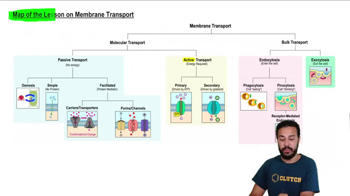
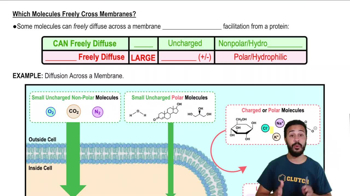
Diffusion is passive movement of solutes down a concentration gradient, affected by gradient size, molecular size, charge, solubility, and temperature.
Osmosis is passive movement of water toward higher solute concentration across a selective membrane, influenced by solute gradient and opposing pressures.
Facilitated diffusion uses carrier proteins to transport materials down a concentration gradient, depending on carrier availability.
Active transport uses carrier proteins and ATP to move substrates against concentration gradients.
Endocytosis is active infolding of the plasmalemma forming vesicles to ingest extracellular fluid or solids, requiring ATP and specific triggers.
Exocytosis is active fusion of intracellular vesicles with the plasmalemma to release contents outside the cell, requiring ATP and Ca2+.
Pinocytosis is cellular "drinking," ingesting extracellular fluid via small vesicles called pinosomes.
Phagocytosis is cellular "eating," engulfing large particles or pathogens using pseudopodia to form phagosomes that fuse with lysosomes.
The cytoskeleton includes microfilaments (actin), intermediate filaments (mechanical strength), thick filaments (myosin in muscles), and microtubules (organelle transport, shape, mitosis).
Centrioles are short cylinders of 9 microtubule triplets near the nucleus that organize spindle fibers during cell division.
Cilia have a 9 + 2 microtubule arrangement, are on the apical cell surface, and propel fluids or materials via coordinated strokes.
Flagella have a 9 + 2 microtubule structure and propel entire cells through fluid, e.g., sperm motility.
Ribosomes are 60% rRNA and 40% protein, with free ribosomes synthesizing cytosolic proteins and fixed ribosomes on rough ER synthesizing membrane or secreted proteins.
Mitochondria have double membranes with cristae and matrix; they produce ATP via aerobic respiration consuming organic molecules and O2.
The nucleus controls cellular activities and gene expression; key features include nucleoplasm, nuclear envelope, pores, matrix, chromosomes, and chromatin.
The ER synthesizes macromolecules, stores molecules and ions, transports substances intracellularly, and detoxifies drugs and waste.
The Golgi apparatus synthesizes, modifies, and packages secretions; packages digestive enzymes; and renews and modifies the plasmalemma.
Lysosomes contain digestive enzymes that hydrolyze ingested solids, recycle damaged organelles, and break down the cell during autolysis.
Peroxisomes digest fats and neutralize toxins, converting hydrogen peroxide (H2O2) into water.
Membrane flow is the continuous recycling and movement of the plasmalemma via vesicular trafficking between ER, Golgi, and plasma membrane.
Tight junctions are interlocking membrane proteins forming impermeable seals that prevent fluid movement between cells.
Gap junctions are transmembrane channels (connexons) allowing direct passage of ions and small molecules between adjacent cells.
Desmosomes are strong mechanical bonds anchoring adjacent cell membranes or attaching cells to the basement membrane.
G0 phase is a resting phase where specialized, non-dividing cells perform physiological functions indefinitely.
S phase involves DNA replication and synthesis of histone proteins, lasting 6 to 8 hours.
Mitosis includes prophase (chromatin condenses, centrioles migrate), metaphase (chromosomes align), anaphase (chromatids separate), and telophase (nuclear envelopes reassemble).
Cytokinesis is the physical division of cytoplasm by cleavage furrow formation, resulting in two daughter cells.