 Back
Cellular Transport - Anatomy & Physiology
 02:44

Terms in this set (20)
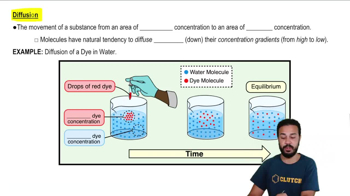
Passive transport is the movement of particles from a region of high concentration to low concentration without requiring ATP.
Permeability depends on whether the membrane is freely permeable (any substance can pass), impermeable (nothing can pass), or selectively permeable (allows some substances but restricts others).
A membrane that allows the free passage of some molecules but restricts the passage of others based on size, charge, shape, and lipid solubility.
Distance to move, molecule size (smaller is faster), temperature (more heat increases motion), concentration gradient, and electrical forces (opposites attract, likes repel).
Simple diffusion for lipid-soluble compounds and dissolved gases; channel-mediated diffusion for water-soluble compounds and ions.
A passive process where carrier proteins transport molecules too large to pass through channels, such as glucose and amino acids.
Transport that requires ATP to move substances against their concentration gradient, often via carrier proteins like the Na+/K+ pump.
Osmosis is the diffusion of water across a selectively permeable membrane toward a solution with a higher solute concentration.
Membrane must be freely permeable to water but selectively permeable to solutes; water moves toward the side with more solutes, increasing volume there.
Osmotic pressure is the force of a concentration gradient of water, equal to the hydrostatic pressure needed to stop osmosis.
The cell gains water, swells, and may rupture (hemolysis in red blood cells).
The cell loses water, shrinks, and becomes crenated.
The phospholipid bilayer forms the physical barrier between the cell's internal and external environments.
It actively transports 3 Na+ ions out of the cell and 2 K+ ions into the cell using 1 ATP molecule, maintaining voltage and cell volume.
Simple diffusion moves small lipid-soluble molecules directly through the membrane; facilitated diffusion uses carrier proteins for larger or water-soluble molecules.
Size, electrical charge, molecular shape, and lipid solubility determine what can pass through.
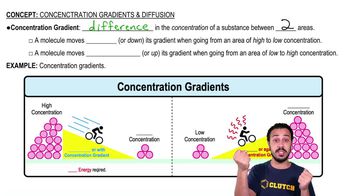
The difference in solute concentration between two areas, driving diffusion from high to low concentration.
Channel proteins facilitate the movement of small water-soluble molecules and ions across the plasma membrane.
Leak channels allow passive movement of ions like K+ across the membrane, contributing to membrane potential.
Because it specifically involves the movement of water molecules across a selectively permeable membrane, driven by solute concentration differences.