Cushions the brain and maintains a stable interstitial fluid environment.
CSF production and circulation
Produced by the choroid plexus at 400–500 mL/day, circulates through ventricles to subarachnoid space, total volume 125–150 mL, reabsorbed by arachnoid villi.
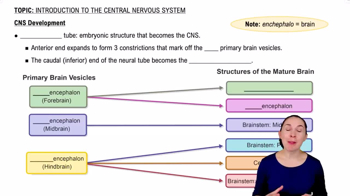
Brain ventricles
Includes lateral ventricles (first and second), third ventricle, and fourth ventricle which connects to the central canal of the spinal cord.
Blood supply to the CNS
CNS is 2% of body weight but receives 15% of blood; brain uses 20% of oxygen and 50% of glucose consumed at rest.
Blood-brain barrier components
Formed by capillary endothelial cells with tight junctions and astrocyte foot processes that protect brain from toxins and pathogens.
Regions lacking blood-brain barrier
Hypothalamic-hypophyseal portal system and vomiting center of medulla oblongata.
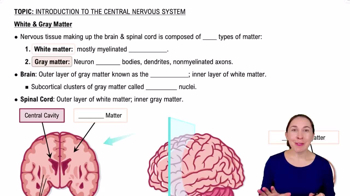
Gray matter in CNS
Contains unmyelinated nerve cell bodies, dendrites, and axon terminals; clusters called nuclei.
White matter in CNS
Composed of myelinated axons; bundles called tracts connect CNS regions.
Types of white matter fibers in brain
Projection fibers, association fibers, and commissural fibers.
Spinal cord length and structure
Approximately 44 cm long, continuous with brain, surrounded by vertebral column, origin of 31 pairs of spinal nerves.
Spinal cord gray matter divisions
Dorsal horn for sensory functions and ventral horn for motor functions.
Spinal cord white matter function
Forms ascending tracts carrying sensory info to brain and descending tracts carrying motor commands from brain.
Spinal nerves composition
Mixed nerves containing both afferent (sensory) and efferent (motor) axons.
 Back
 0:50