 Back
Central Nervous System Anatomy & Physiology
 0:50

Terms in this set (21)
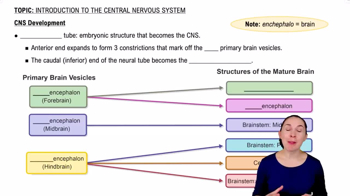
Neurulation is the process where ectodermal cells migrate to form the neural tube, starting just before 3 weeks after conception.
The Prosencephalon (forebrain), Mesencephalon (midbrain), and Rhombencephalon (hindbrain).
The cerebral hemispheres and the lateral ventricles.
It is the primary motor area that initiates voluntary movement, organized as a motor homunculus.
Broca's area is the motor speech area important for producing spoken language.
It is the primary somatosensory area receiving sensory input from the body.
The temporal lobe, including the primary auditory area and Wernicke's area for language comprehension.
It is primarily concerned with vision, including visual association and image recognition.
Commissural fibers connect hemispheres, association fibers connect areas within a hemisphere, and projection fibers connect cortex to spinal cord.
Paired masses of gray matter deep in the cerebrum involved in programmed motor movements and muscle control.
The thalamus acts as a relay center for all sensory input except olfactory before reaching the cortex.
Feeding, Fighting, Fear, and Sex.
Superior colliculi control visual reflexes, and inferior colliculi control auditory reflexes.
It compares intended movement with actual movement using proprioceptive feedback and adjusts motor output accordingly.
It is where corticospinal tracts cross over, causing contralateral control of voluntary movements.
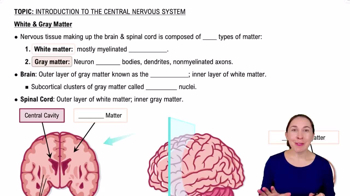
Gray matter is central and butterfly-shaped; white matter surrounds it, opposite to the brain.
Somatic motor neurons that send axons to skeletal muscles.
They carry fine touch, pressure, and conscious proprioception from upper and lower body parts respectively.
Lateral spinothalamic tracts cross over immediately upon entering the spinal cord; dorsal columns cross over in the medulla.
They protect the brain and spinal cord and include the dura mater, arachnoid mater, and pia mater.
Produced by ependymal cells in the choroid plexus of lateral ventricles; flows through ventricles, central canal, and subarachnoid space.