 Back
BackCentral Nervous System Anatomy & Physiology
 0:50
0:50
Terms in this set (26)
The brain and the spinal cord.
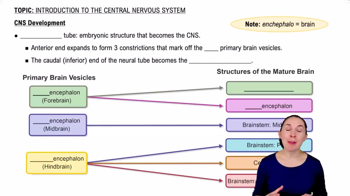
Prosencephalon (forebrain), Mesencephalon (midbrain), and Rhombencephalon (hindbrain).
Telencephalon and Diencephalon.
Cerebral hemispheres from telencephalon, diencephalon structures (thalamus, hypothalamus, epithalamus) from diencephalon, midbrain from mesencephalon, pons and cerebellum from metencephalon, medulla oblongata from myelencephalon.
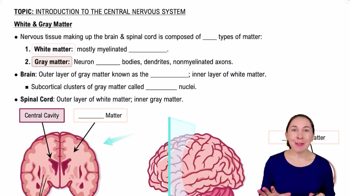
A central cavity surrounded by gray matter (neuron cell bodies) and outer white matter (myelinated axons).
Dura mater (tough outer layer), arachnoid mater (middle web-like layer), and pia mater (delicate inner layer).
They subdivide the cranial cavity and anchor the brain to the cranium.
CSF is a liquid cushion around the brain and spinal cord, produced by the choroid plexuses in the ventricles.
A selective barrier maintaining brain environment; allows glucose, electrolytes, and essential amino acids but blocks most toxins and drugs.
Association fibers (within hemisphere), commissural fibers (between hemispheres), and projection fibers (connect cortex to lower CNS).
They filter out unnecessary movements and are involved in cognition and emotion.
Thalamus, hypothalamus, and epithalamus.
It sorts and directs sensory information to the appropriate cerebral cortex areas.
Controls autonomic nervous system, body temperature, hunger, thirst, sleep/wake cycles, and endocrine system.
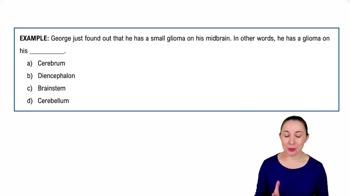
Midbrain, pons, and medulla oblongata.
It is the crossover point where motor control switches to the opposite side of the body.
Coordinates smooth, skilled skeletal muscle movements and maintains balance and posture.
Emotions, memory, and linking higher and lower brain regions.
Broca's area controls speech production; Wernicke's area controls language comprehension.
Controls precise voluntary skeletal muscle movements.
Receives sensory input from skin and proprioceptors for spatial discrimination.
Directs complex learned motor skills and coordinates movements.
Regulates alertness and consciousness.
A bundle of spinal nerve roots extending from the end of the spinal cord.
Contains cell bodies of sensory neurons transmitting signals to the CNS.
Ascending (sensory), descending (motor), and transverse (connect both sides).