 Back
BackCentral Nervous System Anatomy & Physiology
 0:50
0:50
Terms in this set (32)
Central nervous system (CNS): brain and spinal cord, integration and control center. Peripheral nervous system (PNS): nerves outside CNS, includes spinal and cranial nerves.
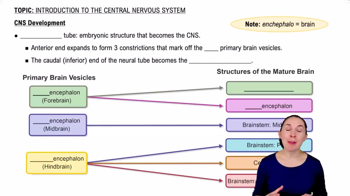
Three primary vesicles form from neural tube: Prosencephalon (forebrain), Mesencephalon (midbrain), and Rhombencephalon (hindbrain). Posterior end becomes spinal cord.
Prosencephalon divides into Telencephalon (cerebral hemispheres) and Diencephalon (thalamus, hypothalamus, epithalamus, retina). Rhombencephalon divides into Metencephalon (pons, cerebellum) and Myelencephalon (medulla oblongata). Mesencephalon remains undivided.
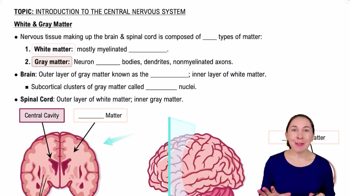
Gray matter contains neuron cell bodies and is found in cortex and nuclei. White matter consists mostly of myelinated axons connecting different brain regions.
Four ventricles filled with cerebrospinal fluid (CSF): paired lateral ventricles, third ventricle in diencephalon, and fourth ventricle in hindbrain. Connected by interventricular foramen and cerebral aqueduct.
Ependymal cells line ventricles and secrete cerebrospinal fluid (CSF), aiding nutrient exchange and waste removal.
Make up 83% of brain mass, divided into five lobes: frontal, parietal, temporal, occipital, and insula. Consist of cerebral cortex (gray matter), white matter, and basal nuclei.
Ridges called gyri, grooves called sulci, and deep grooves called fissures. Important fissures include longitudinal fissure (separates hemispheres) and transverse cerebral fissure (separates cerebrum and cerebellum).
Site of conscious mind including awareness, sensory perception, voluntary motor initiation, communication, memory, and understanding. Composed of six layers of interneurons.
Includes motor areas (voluntary movement), sensory areas (conscious sensation), and association areas (integrate information).
Located in precentral gyrus of frontal lobe; controls precise, skilled voluntary movements via pyramidal tracts.
Anterior to primary motor cortex; plans movements, controls learned motor skills, and coordinates sequential actions.
Located anterior to inferior premotor area, usually in left hemisphere; controls muscles for speech production and planning speech.
Located in postcentral gyrus; receives sensory input from skin and proprioceptors for spatial discrimination.
Posterior to primary somatosensory cortex; integrates sensory input to understand object size, texture, and relationship.
Integrate diverse sensory, motor, and emotional information for purposeful action. Includes anterior association (prefrontal cortex), posterior association, and limbic association areas.
Includes parts of cerebral hemispheres and diencephalon; involved in emotion, memory, and motivation. Key structures: amygdala, hippocampus, cingulate gyrus.
Network of nuclei in brainstem involved in arousal and consciousness. RAS filters sensory input and maintains alertness.
80% of diencephalon; relays, sorts, and edits sensory and motor signals to cerebral cortex; involved in memory and emotion regulation.
Controls autonomic nervous system, emotional responses, body temperature, hunger, thirst, sleep-wake cycles, and endocrine system via pituitary gland.
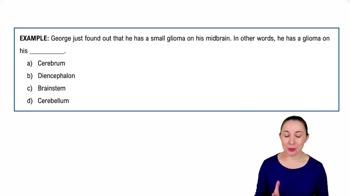
Includes midbrain, pons, and medulla oblongata; controls automatic survival functions and contains nuclei for most cranial nerves.
Autonomic reflex center regulating cardiovascular, respiratory, vomiting, coughing, sneezing, and swallowing reflexes.
Coordinates smooth, precise movements; receives input from cortex, brainstem, and sensory receptors; involved in motor learning and cognitive functions.
Protected by skull bones, meninges (dura mater, arachnoid mater, pia mater), cerebrospinal fluid, and blood-brain barrier.
Dura mater: tough outer layer; arachnoid mater: middle layer with web-like extensions; pia mater: delicate inner layer clinging to brain.
Provides buoyancy, reduces brain weight, cushions CNS from trauma, and nourishes brain while removing waste.
Selective barrier formed by capillary endothelium and astrocyte feet; protects brain by restricting passage of harmful substances.
Extends from foramen magnum to L1-L2 vertebra; protected by vertebrae, meninges, and CSF; contains cervical and lumbosacral enlargements for limb innervation.
Contains dorsal horns (sensory interneurons), ventral horns (somatic motor neurons), and lateral horns (sympathetic neurons in thoracic region).
Contains ascending (sensory), descending (motor), and transverse (commissural) tracts; organized into dorsal, lateral, and ventral columns.
Conduit for sensory and motor signals; contains neural circuits for reflexes and central pattern generators.
Transection causes paralysis below injury: paraplegia (T1-L1), quadriplegia (cervical). Damage to ventral roots causes flaccid paralysis; damage to upper motor neurons causes spastic paralysis.