 Back
ch 10
 8:11

Terms in this set (16)
Axial muscles arise on the axial skeleton (~60%) and position the head, vertebral column, and rib cage.
Appendicular muscles stabilize or move the appendicular skeleton (limbs and girdles, ~40%).
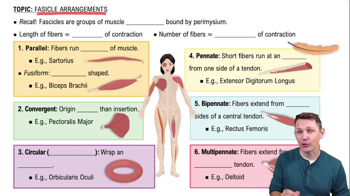
Fascicles run parallel to the long axis; have a prominent belly; allow high range of motion (e.g., biceps brachii).
Broad base narrows to a single tendon; allows versatile pull direction (e.g., pectoralis major).
Fascicles attach obliquely to a tendon like a feather (unipennate, bipennate, multipennate); packs more fibers for higher force but less excursion than parallel.
Concentric rings that constrict openings when contracted (e.g., orbicularis oris).
Fulcrum (F): joint pivot point.
Applied Force (AF): muscle contraction.
Load (L): resistance or weight moved.
Fulcrum is between applied force and load (AF - F - L); example: lifting head off neck.
Load is between fulcrum and applied force (F - L - AF); favors force over speed; example: standing on tiptoes (plantarflexion).
Applied force is between fulcrum and load (F - AF - L); most common in the body; favors speed and range of motion over force; example: biceps curl at elbow.
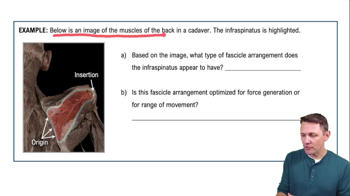
The fixed, stationary end of skeletal muscle attachment, typically proximal.
The movable end of skeletal muscle attachment that is pulled toward the origin.
Muscle whose contraction is primarily responsible for producing a specific movement.
Muscle whose action opposes the agonist.
Muscle that assists the agonist by adding extra pull or stabilizing the origin.
Specialized synergist that immobilizes a joint to stabilize another part of the body.