Skip to main content
Anatomy & Physiology
My Course
Learn
Exam Prep
AI Tutor
Study Guides
Textbook Solutions
Flashcards
Explore
Try the app
My Course
Learn
Exam Prep
AI Tutor
Study Guides
Textbook Solutions
Flashcards
Explore
Try the app
Back
Ch 10 Axial Musculature and Muscles of the Head, Neck, and Eye
You can tap to flip the card.
What is the primary function of the axial musculature?
You can tap to flip the card.
👆
What is the primary function of the axial musculature?
The axial musculature arises on the axial skeleton and functions to position the head and vertebral column and move the rib cage.
Track progress
Control buttons has been changed to "navigation" mode.
1/20
Recommended videos
Guided course
6:31
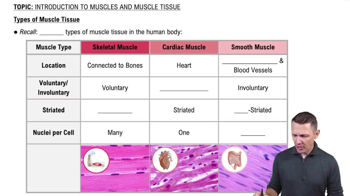
Types of Muscle Tissue
18732
views
494
rank
1
comments
Guided course
2:00
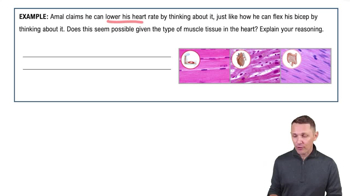
Introduction to Muscles and Muscle Tissue Example 1
16657
views
324
rank
Guided course
4:36
Properties of Muscle Tissue
25639
views
741
rank
2
comments
Terms in this set (20)
Hide definitions
What is the primary function of the axial musculature?
The axial musculature arises on the axial skeleton and functions to position the head and vertebral column and move the rib cage.
What percentage of skeletal muscles are axial muscles?
Roughly 60 percent of the skeletal muscles in the body are axial muscles.
Name the four logical groups of axial muscles based on location or function.
Muscles of the head and neck, muscles of the vertebral column, oblique and rectus muscles, and muscles of the pelvic floor.
What are the main functions of muscles of facial expression?
They control movements such as whistling, sucking, chewing, swallowing, and contractions of the eye muscles.
Which muscles are responsible for moving the eyeball?
The extraocular muscles, including superior, inferior, lateral, and medial rectus, and superior and inferior oblique muscles.
What are the three layers of back muscles in the vertebral column?
Superficial layer (moves the neck), intermediate layer (extends the vertebral column), and deep layer (interconnect vertebrae).
What is the difference between extrinsic and intrinsic muscles of the vertebral column?
Extrinsic muscles are in the superficial and intermediate layers; intrinsic (true) muscles are in the deepest layer.
What is the function of the oblique muscles in the axial musculature?
Oblique muscles compress underlying structures or rotate the vertebral column depending on unilateral or bilateral contraction.
What role do the rectus muscles play in vertebral column movement?
Rectus muscles are important flexors of the vertebral column, acting in opposition to the erector spinae muscles.
What is the diaphragm's role in the axial musculature?
The diaphragm is the primary muscle of respiration, separating the thoracic and abdominal cavities.
What are the three main functions of the muscles of the perineum and pelvic diaphragm?
Support pelvic organs, flex sacrum and coccyx joints, and control movement through the urethra and anus.
Name the major muscles involved in facial expression.
Orbicularis oculi, orbicularis oris, buccinator, zygomaticus major and minor, levator labii superioris, depressor anguli oris, and platysma.
What is the origin and insertion of the sternocleidomastoid muscle?
Origin: Manubrium of sternum and clavicle; Insertion: Mastoid process of temporal bone.
Which muscles are involved in mastication?
Masseter, temporalis, medial pterygoid, and lateral pterygoid muscles.
What muscles control movements of the tongue?
Intrinsic and extrinsic muscles of the tongue, including genioglossus, hyoglossus, and styloglossus.
Name the six extraocular muscles that control eye movement.
Superior rectus, inferior rectus, lateral rectus, medial rectus, superior oblique, and inferior oblique.
Which cranial nerves innervate the extraocular muscles?
Oculomotor nerve (III), trochlear nerve (IV), and abducens nerve (VI).
What is the function of the orbicularis oculi muscle?
Closes the eyelids and helps in blinking and squinting.
What is the function of the buccinator muscle?
Compresses the cheek, aiding in chewing and whistling.
What is the role of the platysma muscle?
Tenses the skin of the neck and depresses the mandible.
 BackBack
 6:31